I always appreciate the different approaches bonsai professionals take with their gardens. Some gardens are filled with exhibit-ready trees while other gardens are filled with project trees. Some focus on a certain size or variety of tree while others include bonsai of every description. At a glance, it’s clear that the focus at Aichi-en is on pine bonsai. White, red, and black pines fill the majority of the garden, and there are more large trees than medium or small sized bonsai. Trident and Japanese maples comprise the bulk of the deciduous trees, but these sit beside quince, ume and hornbeam among other deciduous varieties. There are junipers, cryptomeria, and many other trees whose names I do not know.
From the roof of Mr. Tanaka’s bonsai workshop, one can get a sense of how many trees fill his garden.
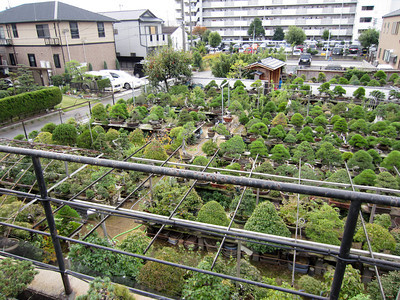
Aichi-en from above
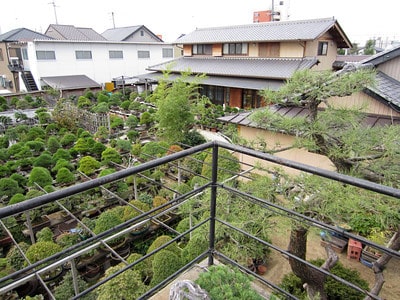
More garden and the family house
Tanaka keeps some trees on the workshop roof.
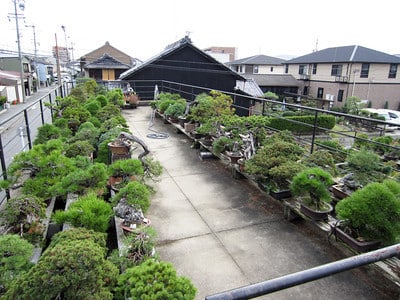
Rooftop garden
Many of the garden’s project trees were kept on the rooftop. The nicer trees were situated closer to ground level.
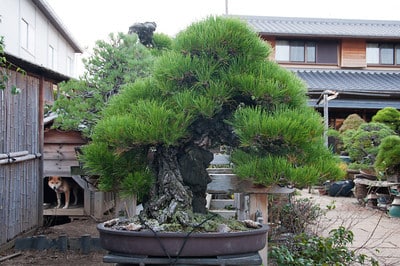
Root over rock Japanese black pine
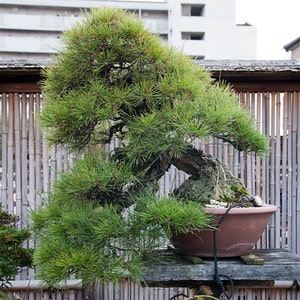
Black pine
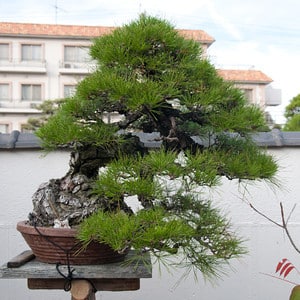
Pine
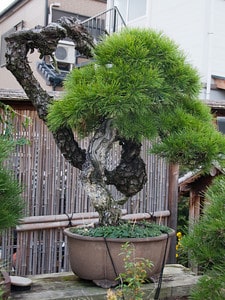
Red pine
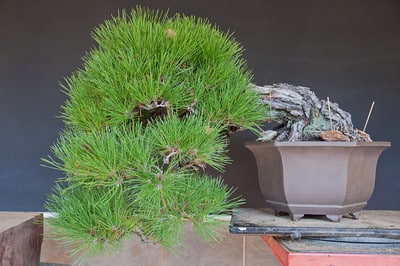
Black pine
Most of the kifu-sized trees shared a staggered table near the house.
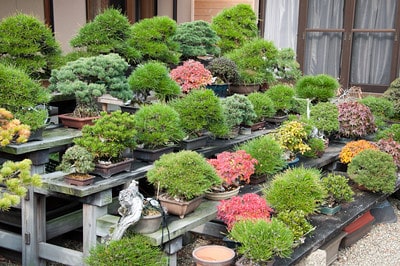
Kifu bleachers
In fall, the colors were wonderful.
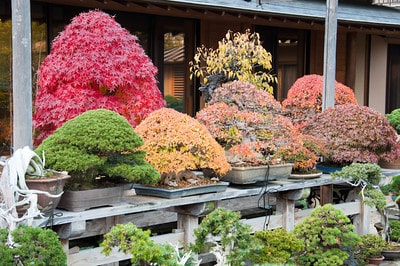
Bonsai Fall color
Up close, the trees were wonderful. Two of the garden’s Zuisho were outstanding.
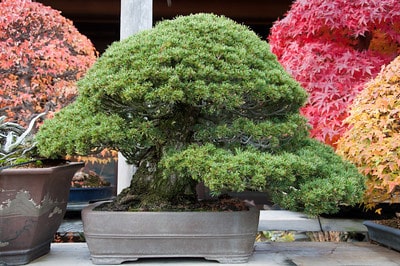
Japanese five needle pine – ‘Zuisho’
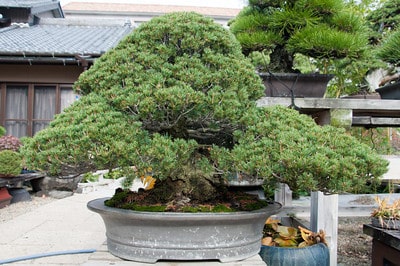
Zuisho bonsai
Considering the small size of Zuisho needles and branches, these are remarkably full trees.
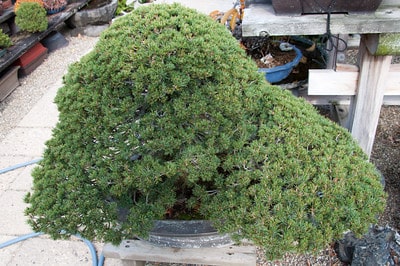
The same tree from above
The Japanse maple beside the front gate turned a wonderful shade of red.
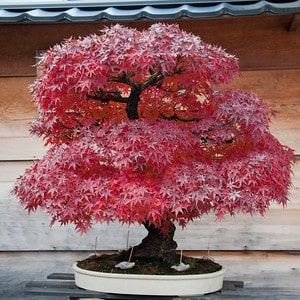
Japanese maple
The pieris below sits right inside the front gate.
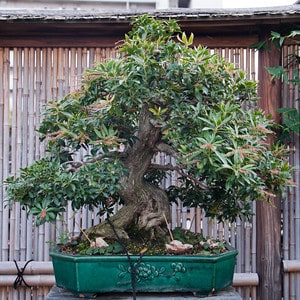
Pieris bonsai
I snapped these shots during short breaks or early in the morning – those precious moments when I was free to appreciate the trees in the garden. Back in the workshop, I appreciated the trees one at a time. The black pine below was one of the last ones I worked on at Aichi-en. I removed all of the old needles and some of the new from the strong areas. In weak areas, I removed some or all of the old needles. I also cut a few small branches where more than two emerged from the same place. It was very basic pine work, but it made the tree look a lot better.
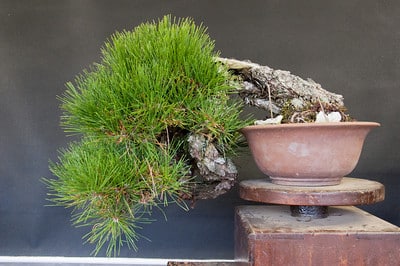
Cascade Japanese black pine
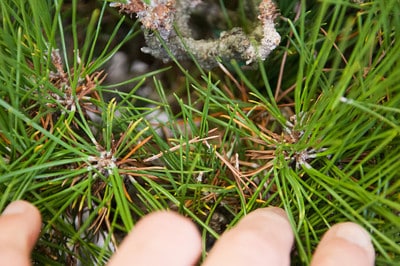
New, old, and dead needles
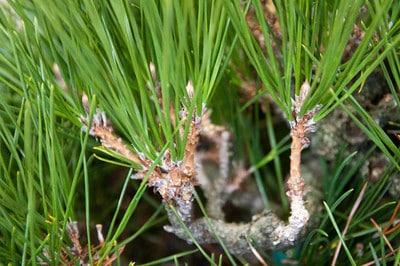
After removing old, dead and some new needles
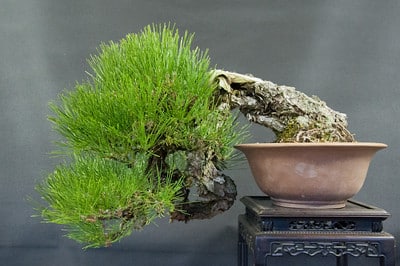
Fall work complete
That’s the story for a single pine. With all of the pines in the garden, that’s a lot of tweezer work.
Subscribe to Bonsai Tonight
New Posts Delivered Every Tuesday and Friday
steve says
Would you mind commenting on what looks to be fertilizer on top of many of the plants in this post? Hopefully this isnt too basic of a question, but I haven’t seen this before. I really enjoy your blog! Steve
Jonas Dupuich says
Hi Steve – what you see are tea bags filled with organic fertilizer held in place with large toothpicks, essentially, of wood or bamboo. It’s a nice technique in that the bags and sticks hold the fertilizer in place. It’s easy to see how much fertilizer each gets and it’s easy to remove the bags in late fall, however, it’s very time consuming – que apprentices – to fill the bags. I don’t know what exactly is in the fertilizer, though it is organic and fairly mild in strength.
Mac says
Jonas, Thanks for the post and the photos. I must be very inspiring to have free access to all those beautiful trees.
Ryan says
Jonas, there is a picture label “red pine” that appears to have a crazy looping trunk. Do you have more pictures of it? Or could you tell us more about it?
Jonas Dupuich says
Hi Ryan – I don’t have other photos of the tree, and I don’t remember its story. Peter Tea knows more about it – you might try asking him.
JAN GOODRICH RENTENAAR says
I have been creating bonsai pots for several years. I specialize in primitive pots. I am so glad I happened upon your website. Viewing your photos gives me a great oppotunity to see a variety of trees and pots. This week I am firing pots at Hiroshi Ogawa’s wood fired Naborigama. Thanks for the inspiration, Jan Rentenaar
Bruce Winter says
I’ve been using tea bags a few years now. The local garden center has a mix of cottonseed, blood and bone meal…perfect! Yakitori sticks work well.
steve says
Sweet thanks. I might have to give that a try, while i can see it being time consuming it seems easier than making fertilizer cakes. thanks again, steve
Mac says
The squirrels and chipmunks around here would take them as a package lunch.