Sacramento Bonsai Club – 64th Annual Show
Sacramento Bonsai Club’s 64th Annual Show
The Sacramento Bonsai Club held their 64th annual show this past weekend at the Sacramento Buddhist Church. The event left quite an impression. The exhibit showed how fun a spring show can be. The suiseki displays were a super addition to the show. And the 40 or so happi-coated club members were one of the nicest bonsai groups I’ve run into. Sacramento Bonsai Club is doing great after 64 years.
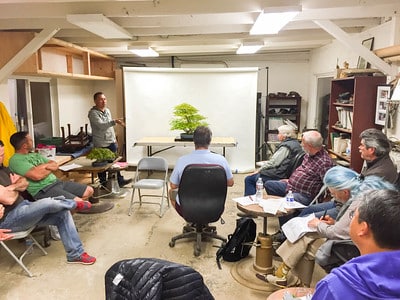
Boon Manakitivipart provided demonstrations both days and the event was well-attended. As the Sunday demonstration cleared most of the exhibit, I had a chance to to take some pictures.
The juniper below is one of two Members’ Choice Award winners at the show.
Members’ Choice Award – Juniper
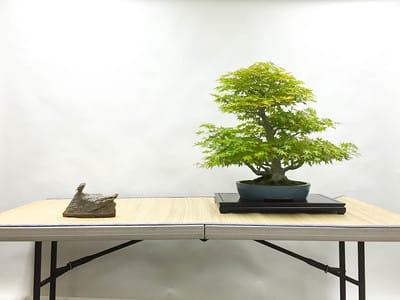
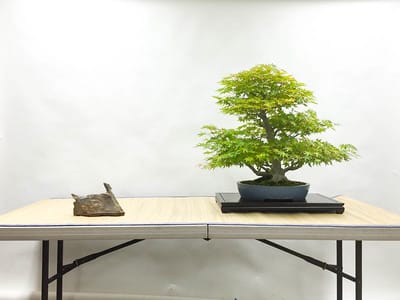
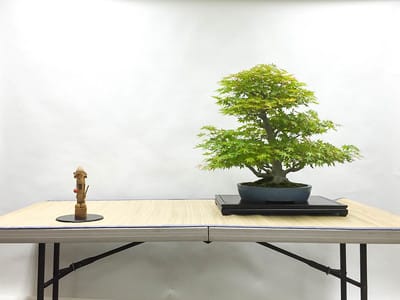
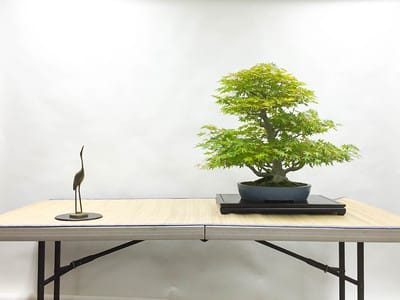
The trident maple bonsai display below is a good example of some of the well-thought out displays. I like the addition of the pale-blue – almost Kokufu-felt blue – screen behind the display. It’s a nice way to highlight the relationships among display elements and it does a good job of obscuring the backdrop support.
Trident maple
A number of trees were in full-bloom for the show. The satsuki azalea below was the brightest.
Satsuki azalea
As I walked into the exhibit, I met Greg McDonald, a club member that contributed several trees to the show. Like his brother Jay, Greg has some great deciduous trees, including the hawthorn below.
Hawthorn
Greg’s unsure about the variety of this hawthorn – not a big surprise considering the size of the crataegus genus, but an anomalie for a hawthorn enthusiast like Greg. He’s also doing a great job with the oaks below.
Coast live oak
Interior live oak
More highlights from the show.
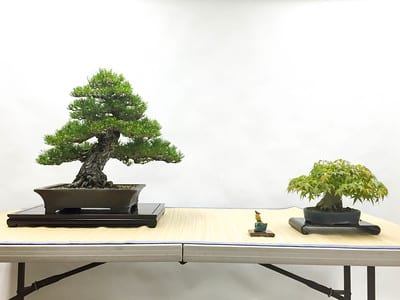
Japanese maple and Japanese black pine
Shimpaku – itoigawa
White pine
Japanese flowering apricot – Prunus mume, commonly known as ume
Ginkgo
Juniper
White pine
California juniper
Boston Ivy
Japanese maple
Coming soon – more highlights from the show including some uncommon varieties for bonsai, suiseki displays, and spring accent plants.
Case study: balance
Balance is one of my favorite topics for bonsai discussions. The term can be used broadly – I recently mentioned a few of the possibilities in relation to trees exhibited this year by the Bay Area Bonsai Associates.
One of the more primary considerations is whether a tree points left or right. Getting direction right has a big effect on a tree’s overall balance and is key to setting up formal displays. Just this week I’ve had several discussions about the direction of the tree below. It’s a Japanese black pine.
Black pine silhouette
It’s a great case study. Looking at it brings up a number of questions for me.
- Does the tree point left or right?
- What makes you think so?
- Does the tree have good balance?
- Would the tree look better if it pointed the other direction?
- Are there areas for improvement?
I’m curious to hear what you think about it: feel free to share your ideas – even if it’s your tree!
Bonsai Stands
Bay Island Bonsai maintains a tradition of putting its newest members in the spotlight. Since the organization got its start back in 1998, new members have been subjected to the bonsai “stand exercise.” A group of stands are placed on a table and new members are given the instruction to “arrange them from least formal to most formal.” No other explanation is given.
At a recent meeting, one of our new members included John Thompson, one of the more talented and experienced bonsai artists among us. Here he gets “help” from Jeff and Peter.
John, Jeff and Peter arrange stands
The exercise usually brings up two questions: 1) What makes one stand more formal than another; and 2) What’s the point of the exercise?
Having watched the exercise unfold for over ten years, it’s clear that most people can supply a pretty good definition of what passes for “formal” without formal bonsai training. Flat bamboo “stands” commonly used for accent plants are usually found to be less formal than taller rectangular stands. Slabs are usually found to be less formal than natural root stands.
Rigid, concrete guidelines can be hard to come by. In general, straight lines are more formal than curved; tall – to a point – is more formal than short; and dark colors are more formal than light. How do tall stands with strong curves and dark colors compare with short, powerful stands with ornate detail? That’s where things get interesting.
Both stands are dark and make use of curves – which is more “formal”?
Where does the tall, octagonal stand with intricate details and strong lines fit in?
After getting a feel for gauging formality, one commonly asks why it matters. The answer I’ve held onto the longest begins with an extreme case.
In formal or semi-formal bonsai displays – for these purposes, bonsai displays with trees, stands and accent plants – the stands used can have a big effect on the display’s esthetic. Imagine placing a Japanese black pine with a thick trunk on a ceramic disc next to a tall stand with heavy legs supporting a delicate accent plant. Such an arrangement could put a lot of focus on the accent while downplaying the pine. If the goal is to engage viewers with the pine, one needs to select a stand appropriate to the purpose. This is one reason why I like this exercise – it helps us create the effects we are looking for when we assemble a display.
It also causes us to look at stands closely. The best are beautiful objects on their own. For being quite simple, the sweeping curves on the stand below create a lively, almost playful effect for such a strong and squat stand.
Great curved legs
The stand below is an interesting contrast – it is short and strong with powerful legs that quickly taper to delicate feet. It’s hard to find a good tree for this stand, but well worth the challenge.
Such tiny feet!
The stands below share several characteristics. They are taller than they are wide and they fit in the general square/round category. In other words, these stands serve well for trees with square, round, or other pots that aren’t rectangular. Which is more formal? I’d vote the stand on the left. It’s taller, darker, heavier – it appears sturdy – and predominantly features straight lines.
More formal and less formal bonsai stands
Good root stands are a pleasure. They’re super for cascade and semi-cascade bonsai in bonsai exhibits, and good for all sorts of things around the house the rest of the year.
Root stand
Spring bonsai display
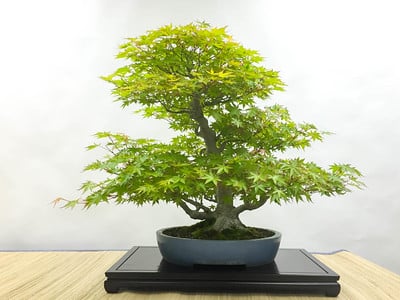
Bay Island Bonsai’s annual exhibit is held in January each year. It’s a great time to show bonsai, but it’s not always the most colorful time of year. At a recent BIB monthly meeting, we worked on a display that included a Japanese black pine and a Japanese maple. In winter, the maple would be bare. In spring, the foliage is bright green.
Boon setting up a display at a BIB monthly meeting
Or bright red. Boon brought two maples to try with the display, one green and one red.
Green and red Japanese maples
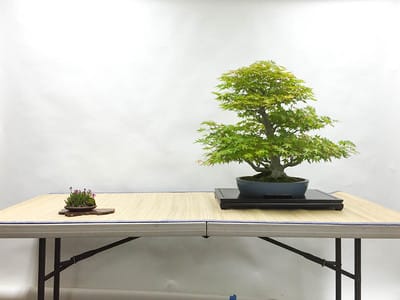
Matching these maples with the appropriate accent plant made for an interesting exercise. For example, no one liked the two green elements together.
Maple with grass
Contrasting red and green helped with the color, but in the example below, the accent struck many as quite large compared with the tree it complemented.
Maple with succulent
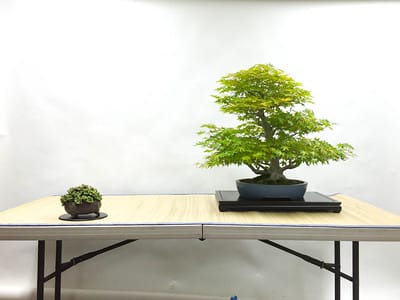
Swapping the red succulent for a smaller green accent solved the size problem, but reintroduced the green-with-green problem.
Maple with small accent
This became a good opportunity to try the red maple. The red maple looked pretty good with the pale green grass.
Red maple with grass
Swapping the grass for the red succulent worked better than expected as the white flowers and green leaves stood out well against the red maple foliage. Overall, however, the accent struck many as large for the small maple.
Red maple with succulent
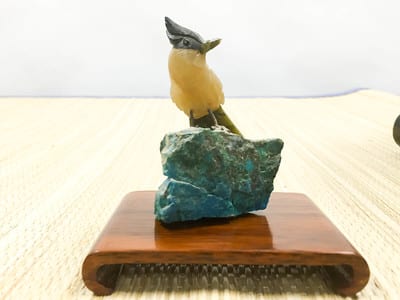
The small green and yellow accent made the maple look relatively large and provided good color contrast. Which is lucky, because this combination provided nice balance to the main tree, a Japanese black pine.
Red maple and accent
Black pines look great with red maples. With the first and second tree set, the goal is to find appropriate stands and accents.
Color-wise, the accent below is a good fit for the display. But it position strikes me as funny – it’s not clear whether it is meant to complement the maple or the pine. A small matter, really, when we consider the stand for the pine.
The pine has a very powerful trunk with deeply furrowed bark. It has strong movement and a heavy pot. The stand, in sharp contrast, is delicate and feminine – more delicate than the stand for the maple.
Getting closer – a good mix of colors
The shot below reveals the combination that best pleased the crowd. The stand for the pine is taller and stronger. The red maple foliage contrasts well with the green pine foliage and the white accent pot provides nice punch.
Final display
Were more elements available, we feel we could further improve the display. This a good reason for testing out displays so far in advance of the exhibit – finding missing display elements isn’t always easy. For this display, we’re off to a good start.


8 comments