Bonsai Tonight

Hinoki workshop

Posted in Before and after, Bonsai Development, Styling by xwires on August 20, 2010

Hinoki workshop

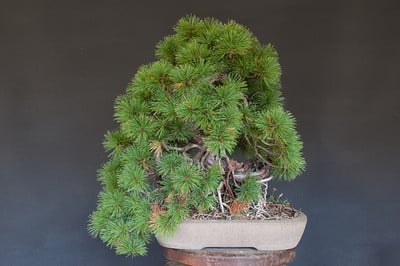
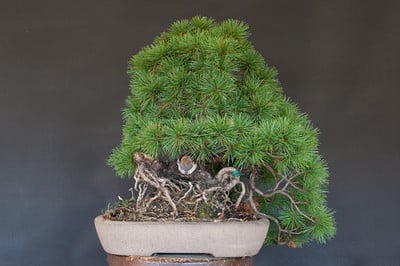
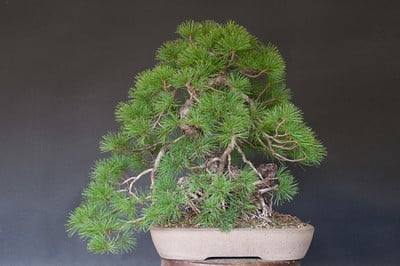
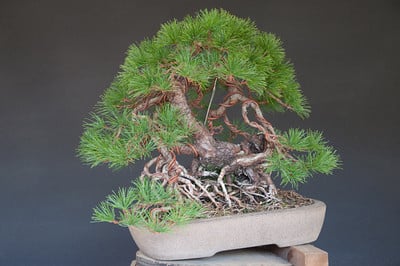
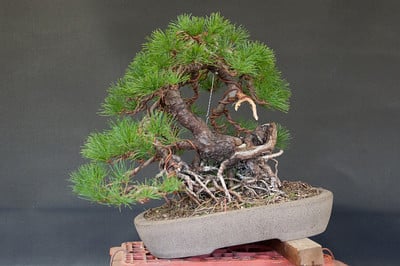
Last weekend I had the opportunity to attend a Bay Island Bonsai workshop run by Daisaku Nomoto. I selected a tree I’ve been working on for the past 15 years – a hinoki. The tree improves every year, but slowly, as hinokis are notoriously slow growing. A year and a half ago, Boon and I performed some heavy bending to get the main branches closer to where we wanted them. This year the work really paid off. Here are some before and after pictures:

Front – before

Front

Front – after

Right – before

Right – after

Left side – before

Left side – after

Back – before

Back – after

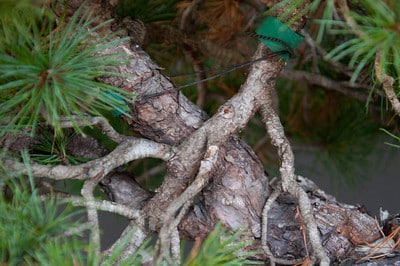
The biggest change came when Nomoto removed the first cluster of branches on the left. We discussed this ahead of the workshop and I assented to the cutting. Here’s the branch as it appeared before the workshop with guy wires holding it in place.

Before – guy-wires are doing most of the work

There were two good reasons for removing these branches. First, they blocked the view of the trunk. Second, by replacing branches that grew low on the trunk with branches that emerged higher up, we could bend these branches at a steeper angle. The idea is that older branches tend to hang lower than younger branches.

Removing the branches – stubs will be used for jins

Nomoto removed enough foliage to make a hinoki fan.

Minor cutback and wiring filled the rest of the day. Nomoto moved between workshop participants, cutting, wiring, and offering advice as appropriate. When he got back to me, he typically set a few branches and told me to continue wiring.

Adjusting a branch

Nomoto setting a branch – note use of pliers

Nomoto applying wire

I occasionally looked up from my work to see what else was going on in the workshop. At one point, Nomoto was performing heavy bending with rebar. With a branch in one hand and pliers in another, he kept the rebar in place with his knee.

Heavy bending – prostrata juniper

Fortunately for me, the hinoki needed far less dramatic work, like the plucking of unnecessary foliage.

After setting a branch, Nomoto took care to remove any downward growing foliage. This creates well-defined pads and reveals the age of the tree by exposing the branches that comprise the pads.

Hinoki branch pad

As is often the case in re-stylings, the trick is getting the apex right. While the current silhouette is close to where I want it, some shoots weren’t long enough to fill in where I need them. It’s easy to see this from above.

Seen from above – after re-styling

I’m really happy with the way the tree turned out. For one, it finally approximates the design I had in mind for it 15 years ago. Even better, I now have a tree I can show in Bay Island Bonsai’s upcoming exhibit next January.

Happy with the results – excess foliage cover the turntable

Now 15 years in, I feel like I’m half-way there, and it’s a great feeling.

Daisaku Nomoto bonsai critique

Posted in Bonsai Development, Styling by xwires on August 6, 2010

Daisaku Nomoto bonsai critique

It always feels good to be a member of Bay Island Bonsai. This week it feels great. Bonsai professional Daisaku Nomoto of Miyazaki, Japan, provided the program for this month’s meeting. It was a critique – members were invited to bring trees for comment and some minor re-working. Turned out to be a great evening. Here are some of the trees and comments they elicited.

The first tree under consideration was a Japanese black pine. Nomoto wanted the movement of the silhouette to reflect the movement of the trunk, so he suggested some minor cutback. The tree’s owner gave the ok, and Nomoto got to work.

Acting out the movement of the tree

Nomoto demonstrating the tree’s movement

Note the shoot pointing downward in front of the trunk – removing it shifted some emphasis from one side of the tree to the other

Nomoto adjusting branches with pliers and finger

A few more adjustments

The result

The chopstick indicates the relationship between the apex and the center of the trunk. This relationship has a big effect on the tree’s overall balance.

The pinyon pine below was a gift to Boon from Michael Hagedorn. The tree has grown steadily for a number of years and is ready for a styling. Nomoto suggested removing the foliage on the left side of the tree to emphasize the bunjin movement of the trunk. Instead of removing the foliage all at once, he recommended removing it over time to preserve the lifeline defining the shari along the trunk.

Noting the future location of the first branch

This section of the lifeline feeds the foliage to be removed. Removing the foliage over time decreases the odds that the lifeline will die back in the area to which Nomoto is here pointing.

Applying wire

Nomoto was very impressed with the small Olive below. He mentioned several times his desire to take the tree back to Japan. Why? He tells us that small olives with such great trunks are quite rare in Japan, and that this specimen is a great candidate for the Kokufu Exhibit.

Admiring the olive

Nomoto’s one suggestion was to change the angle at which the tree was planted. By tilting it forward, the trunk rose straight into the air rather than leaning back.

The suggested planting angle

Suggested planting angle from the front

I was very impressed by the material that showed up for the meeting. Many of these trees have yet to be shown, however their quality was great. The juniper below has a super trunk and awaits a styling before it’s ready for exhibit. Nomoto’s suggestion was to plant the tree lower in the pot. The relatively narrow base of the tree creates some reverse taper which distracts from the overall power of the trunk. By planting the tree lower, the base of the tree looks larger in relation to the rest of the tree.

Sierra juniper – note subtle reverse taper at base of trunk

Suggested planting depth and pot style. This pot is a bit too small for the tree, but the style and color make a great match

A very mature Sawara cypress elicited a single recommendation. The tree’s current silhouette is quite round. Nomoto suggested a more triangular silhouette.

Sawara cypress and chopsticks

After asking some basic questions about the variety, Nomoto offered to trim a few branch pads on the boxwood below to demonstrate how more, smaller pads can make the tree look older and more developed.

Trimming boxwood foliage to create smaller pads

Another collected juniper elicited some interesting suggestions. For the jin below, Nomoto suggested gouging out the channel just to the left of the old lifeline to create more interest.

Examining the deadwood

He also suggested removing most of the trunk. The pinyon branch stands in for the future key branch.

Juniper with towel and pinyon foliage

The first goal for the very old cedar below is to return it to health. It’s come a long way in the past year, but still has a bit to go before it can withstand significant styling. Nomoto recommended removing the branch that emerges at the first bend in the trunk. His first preference was to leave no jin behind, providing the wound can heal properly, though he thought a small jin could also be appropriate.

Appraising an old cedar

The fantastic juniper below was grown by Jim Gremel. Nomoto wanted to reduce the canopy a bit. To do so, he recommended removing the first branch. This branch grew upwards and formed somewhat of a second trunk. Removing it would leave room for one of the upper branches to fill in and provide a more appropriate silhouette.

Seen from the front – great movement

The foliage at the right emerges from the branch Nomoto suggests removing.

Thanks go to Boon for arranging for Nomoto’s visit. It’s quite a treat to have such talent at a 30-person club meeting, commenting on our trees. I understand what a special occasion this is, and I appreciate it greatly!

Cork bark Japanese black pine – finding the front

Posted in Styling by xwires on July 23, 2010

Cork bark Japanese black pine – finding the front

Finding the front of a bonsai is a great exercise – one of my favorites. Both existing bonsai and newly collected trees make good candidates. The cork bark black pine I’ve been working on for the past 6 years has had the same front for very likely most, if not all, of its life. Here is a photo of the tree from 2004.

Cork bark black pine - winter 2004

Winter – 2004

The tree was very yellow that year as it hadn’t received much water the previos year. That spring, almost all of the needles fell off leaving very little foliage to keep the tree alive. After two significant repottings and several years of attentive care, the tree is back in good health. Which is a good time to consider how it’s styled.

Were I to remove the top quarter of the tree, the bit that protrudes to the right, I’d have a nice ready-made bonsai. Future work would require finding a smaller pot and further developing the existing branches.

Corkbark Japanese black pine - after decandling

Spring – 2010

I’m not convinced, however, that keeping this front will yield the most interesting bonsai. I’ve long considered how I might take advantage of the top part of the trunk and the best I’ve come up with involves selecting a new front for the tree.

This is tricky for existing bonsai. The branches are well distributed for the existing front and the trunk and root-base currently show well. But when I look at the tree from the right side, the trunk gains movement and character. Of course, when viewed from this side the root base narrows – typically a bonsai no-no – and the branch structure falls apart. Were I to make the switch, I’d have to find a way to work with these deficiencies. Here are several views from the right side.

New front #1

New front #2

Front #3

New front #3

New front #4

It’s not going to be an easy decision. For although I find the possibilities intriguing, they might not yield the effect I’m looking for.

The current front provides a nice, wide root-base and good interest.

Trunk detail – current front

The new front could provide a slightly wider trunk, at the expense of a much narrower root-base. There is great visibility of the trunk, below and above, but at the expense of poor branch structure.

Trunk detail – candidate for new front

The back of the tree offers good view of the trunk and root-base but no branches whatsoever. They can’t all be fronts.

Trunk detail – current back of tree

Case study: balance – follow-up

Posted in Styling by xwires on April 27, 2010

Case study: balance – follow-up

The tree from Tuesday’s Case study was shown this past January at Bay Island Bonsai’s 11th annual exhibit.

Japanese black pine as shown at BIB’s 11th annual exhibit

I hope Boon will share the tree’s story some day – it’s a good one. The tree has been in development for a long time from nursery stock and is looking really good. Here’s a close-up showing the spring candles. Note how well the tree’s strength is balanced from top to bottom.

Spring candles on Japanese black pine – the tree is in great health

Based on your comments, the tree’s balance is, overall, very good. The tree decidedly points left and can benefit from subtle refinements to its silhouette.

Japanese black pine silhouette

As Janet mentions, the upper part of the trunk moves strongly to the right. It makes great counterpoint to the left-leaning sections of the trunk above and below and provides the tree with good movement. It’s strong enough, I believe, to support an apex that points right instead of left. But as Peter mentioned, that would make for a different tree, not necessarily a better one.

Graham’s comment about growing out the apex intrigues me. Making the tree taller could provide very interesting opportunities for altering the tree’s balance, but at the expense of downplaying the tree’s powerful trunk. The comment also made me wonder about extending the trunk, but after getting a look at this, I changed my mind. Making it shorter, on the other hand, produced a surprisingly pleasant effect.

Silhouette with the trunk removed

In response to Jeremiah’s question, a tree’s key branch, as I understand it, always points the same way as the tree’s apex. The key branch is not necessarily the largest or most pronounced branch on a bonsai – it is the branch that reinforces the direction of the apex.

On a related note, thanks to Mike for capturing so well Michele Andolfo’s description of what makes an apex point one way or the other. To paraphrase, making one side of the apex longer than the other side creates movement toward the shorter side. I’ve long thought that getting this bit right is one of the more important design considerations in bonsai.

Tagged with: ,