Bonsai Tonight

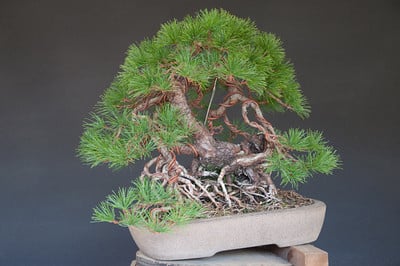
A twisting black pine

Posted in Before and after, Styling by Jonas Dupuich on November 22, 2011

A twisting black pine

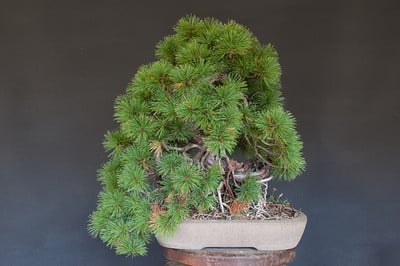
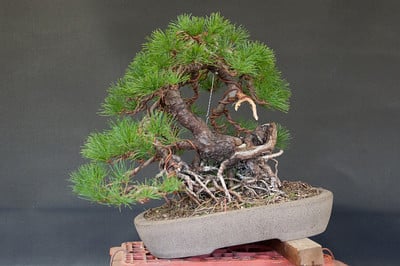
The back pine below appeared on the turntable and I was asked to make the tree “more beautiful.” What an unusual tree!

Front

Twisted pine

Before looking very closely, I immediately got to work plucking old needles. That gave me a chance to study the tree and let me put off figuring out what to do with it. Once the tree was clean, Oyakata – Mr. Tanaka of Aichi-en – asked what I wanted to do with the tree. I said I wanted to make it more compact and wanted a tiny bit of foliage to poke out on the right side. I thought about doing that by bending the top part of the trunk to the right. That would have the effect of undoing the final curve in the trunk. Tanaka suggested that I think about bending the trunk even further to the left. If the tree is funky, go with it, he said. Sounded great to me. I haven’t done a lot of heavy bends on black pines so I had fun wrestling branches with bare hands and jacks to get it into shape.

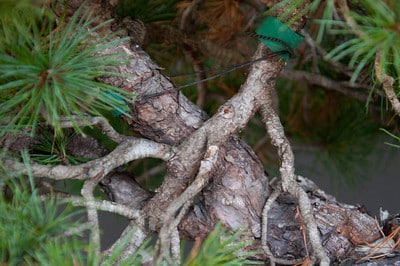
Guy wire

Stainless steel guy wire

This opened up quite a few cracks along the branches. I was told they’d heal just fine, so I added cut paste and moved on to the next bend.

Splitting

Openings in the bark after making a severe bend

Before long, the branches were covered with screws and wires.

Guy wire

The result of bending the trunk 4″

Guy wire

Guy wire with screws

Jin

Jin

Wired branches

Branches wired

When I finished positioning the branches, Tanaka spent a few minutes pointing the branches upwards and moving them closer to the trunk. I had positioned the braches farther apart and pointed the buds outward. Why make the change? Mostly to improve the tree’s silhouette.

Front - after

Wiring complete

It was 10:30 p.m. when I finished working on the tree – about 12 hours in the workshop. What a fun way to start a bonsai vacation!

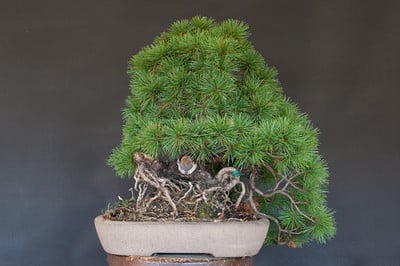
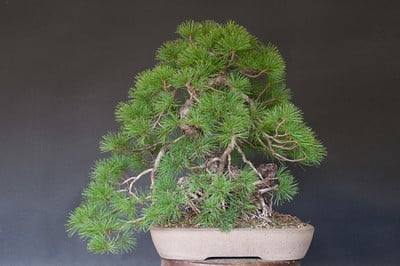
Here are some shots of the tree from different angeles to offer a better idea of how twisted the thing is.

Front

Front – before

Front - after

Front – after

Right side

Right – before

Right side - after

Right – after

Left side

Left side – before

Left side - after

Left side – after

Back

Back – before

Back - after

Back – after

I’ll be curious to see how the branches withstand the big bends. I’ll ask Peter Tea for a photo if the tree’s still around next year.

Tagged with: , , , ,

Which way does it go?

Posted in Styling by Jonas Dupuich on August 26, 2011

Which way does it go?

I brought my hinoki to a Bay Island Bonsai workshop last weekend. It was the first time I’d thought much about the tree since I worked on it last year. It had filled in quite a bit and I wanted to give it some attention. I also had yet to decide what tree I’d be showing at BIB’s upcoming exhibit in January. Boon and I looked at the tree briefly and figured it was close enough to ready for exhibit. As is so often the case, I’d prefer wait a few more years before showing the tree again, but decided, ultimately, that it would be fun to show it at next year’s exhibit and then again in two years when it’s further along.

I first showed the tree at BIB’s inaugural exhibit in 2000. Every few years I remove the lowest branches and re-style the remaining foliage. Between exhibits, the tree has a chance to fill in a bit. To keep the tree full for next January’s exhibit, I don’t want to remove much foliage. For this workshop, I simply removed the yellow and brown foliage and started thinking about the tree’s silhouette.

Hinoki

Hinoki (12″/30.5cm) – summer 2011

Before removing old foliage

Old and new foliage

After removing old foliage

Old foliage removed

Cleaning up the old foliage made it clear that the tree was full enough to show. But what struck me, is the direction of the tree.

I asked others in the workshop what they thought. Some suggested the tree points to the right. I think the lowest branch on the right does point to the right, and I desire for the tree to point right. I’d argue, however, that the apex points decidedly to the left. To create balance, the key branch must point in the same direction as the apex. This tree is close to balanced, but not quite there yet.

Hinoki - front

Hinoki – which way does it go?

I noticed, as I looked closely at the tree, that as I rotate it to the right, the direction of the apex shifts from left to right.

A few degrees to the right

Apex left, key branch right

A few more degrees to the right

Neutral

Still further to the right

Apex beginning to point to the right

Although the tree’s silhouette looks pretty good from this angle, it’s not a suitable front for the tree as the key branch points away from the viewer. The photo is useful, however, because it suggests to me how to style the branches and apex to create balance.

Do all of these shots look the same? Are some angles more interesting than others? Am I being picky? Good questions! I’m hoping to re-set the branches before exhibit to improve the tree’s balance. Not all of the tree’s branches are long enough for me to create the silhouette I’m looking for, but I can get closer to my ideal ahead of the exhibit. Time for more wiring!

8/29/2011 update – see virtual by Michael Pollock on Flickr.

Tagged with: , , ,

Kondo critique at Bay Island Bonsai

Posted in Styling by Jonas Dupuich on August 12, 2011

Kondo critique at Bay Island Bonsai

This month’s Bay Island Bonsai meeting was devoted to a bonsai critique by Akio Kondo. Kondo discussed the good and bad points of each tree, making suggestions for improvement and answering questions along the way. Occasionally – to our general encouragement – he pulled out scissors and made a few cuts. Here are some of the trees he looked at.

Kondo working on a Japanese maple

Japanese maple

Kondo thought this Japanese maple is well on its way. The tree has good roots thanks to an air layer. Kondo suggested that the best time to layer maples is right before new leaves open in spring.

Result of air-layering

Japanese maple – uniform roots are a sign of layering

Jim Gremel brought a San Jose juniper with kishu shimpaku foliage. We talked about the pot. The ideal pot would be somewhat smaller, maybe with scalloped edges.

Kishu shimpaku, grafted on San Jose juniper

Shimpaku

Trunk detail

Shimpaku – trunk detail

Kondo also suggested making a small jin. After cutting away the foliage, Kondo recommended filling the gap with a small branch.

Removing the branch left a small gap

New jin – look beneath the apex on the left

Filling the gap

Filling the gap

Kondo next commented on a California juniper with shimpaku foliage.

California juniper

Sizing up a California juniper

He made basic recommendations for the main branches. He wanted the first branch on the right to be larger and a little lower; the left branch could be lowered; and the top right and left branches at the base of the apex could also be lowered.

Shimpaku grafted on California juniper

Kondo indicating future branch positions

Another California juniper proved tricky. The narrow trunk emerged vertically before expanding and teetering off to one side like a wave. To improve the taper of the tree, Kondo recommended changing the soil line.

California juniper - trunk detail

California juniper – trunk detail

Future soil line

Suggested soil line

Planting the tree deeper and changing the angle at which it is planted would widen the base of the trunk and make the tree appear more powerful.

California juniper

California juinper – right side

Kondo’s advice for a cork elm was simple – all of the main branches needed to be lower. He suggested using guy wires and doing the work incrementally to avoid stressing or breaking important branches. He thought a “white” pot – what we would consider to be dirty white or even yellowish – or blue pot, oval in shape, would make a good container for exhibit.

Cork elm

Cork oak

A third California juniper elicited a term from Kondo with which none of us were familiar. He said the tree could be an example of the kawarigi style, a style in which all of the branches emerge from roughly the same spot. I’m not confident that we fully understood what he was trying to convey about the style. We were clear, however, when he mentioned refining the jin at the tree’s apex and suggested a front for the tree that made good use of the deadwood along the trunk.

California juniper

California juniper

A prostrata juniper proved a good exercise in selecting the front of a tree. Here’s the tree from the current front.

Current front

Prostrata juniper – current front

Kondo suggested tilting the tree slightly to give it better movement.

New front

Prostrata juniper – new front

He then pointed out the good deadwood on the other side of the trunk. This, he suggested, would make an even better front.

Deadwood on trunk

Trunk detail with deadwood

Kondo thought the front without deadwood would make a good front maybe three years from now, and that the alternative front would make a good front roughly 10 years from now.

Future front

Future front

Using this front would take longer because the branches needed to complete this front need more time to develop. For both fronts, Kondo recommended making the silhouette much smaller to improve the balance between foliage and trunk. He also suggested grafting two new branches in the tree’s interior to fill some open areas.

I’ve always liked the idea of taking advantage of different “fronts” over time. In the case of this prostrata, the owner can show the tree sooner rather than later and still have a somewhat “new” tree to show down the road.

Tagged with: , , ,

Evaluating bonsai

Posted in Styling by Jonas Dupuich on July 8, 2011

Evaluating bonsai

As we prepared to begin a judging exercise at this month’s Bay Island Bonsai meeting, Morten asked a good question. It was something to the effect of, “Is the highest scoring tree the most valuable tree?” I knew the two were closely related, but had to think for a moment before coming to a conclusion. The trees to be judged included three shimpaku, an azalea, and a stewartia.

Tree #1 - Shimpaku

Tree #1 – shimpaku

Tree #1 - Shimpaku, trunk detail

Tree #1 – trunk detail

Tree #2 - Satsuki azalea

Tree #2 – azalea

Tree #2 - Satsuki azalea, trunk detail

Tree #2 – trunk detail

Tree #3 - Shimpaku

Tree #3 – shimpaku

Tree #3 - Shimpaku, trunk detail

Tree #3 – trunk detail

Tree #4 - Stewartia

Tree #4 – stewartia

Tree #4 - Stewartia, nebari detail

Tree #4 – root detail

Tree #5 - Shimpaku

Tree #5 – shimpaku

Tree #5 - Shimpaku, trunk detail

Tree #5 – trunk detail

The BIB judging categories include (see “Evaluating Bonsai at BIB Meeting” for details): trunk (1-10); branches (1-5); rootage (1-5); pot selection (1-5); aesthetics (1-5). After members completed their judging forms, we reviewed our scores together. The sums of the scores were 25, 22, 18, 16, and 15. Can you guess which trees earned which scores?

These scores, it turns out, were a pretty good indicator of the relative worth of these trees. What the scores don’t account for is potential. If a great tree has rangy branches and an inappropriate pot, it will score poorly. That may, in some cases, indicate a good buying opportunity. I reflected, at this point, about my own criteria for buying bonsai. I typically ask two questions of the trees I consider buying:

How good is the trunk?

Can I fix the defects?

Healthy trees with great branches and great roots, even when potted in great pots, aren’t worth much if the trunk lacks age, character, and beauty. These are hard characteristics to fix, and hard characteristics to fake.

After the judging exercise, we set up sample bonsai displays. We had trouble finding the perfect stand for the pine below. In character, the slab on which the pine sits is a great match, but it’s thickness was a bit much for some members.

Black pine display

Shohin black pine

We tried pairing the pine with a star magnolia.

Star magnolia

Star magnolia

Star magnolia - trunk detail

Star magnolia – trunk detail

The magnolia is very full this time of year – so much so that it took a while for us to figure out which side was the front. That the rootbase was so good from both front and back is a clue that the mighty magnolia will look great when it loses its leaves this winter.

Follow

Get every new post delivered to your Inbox.

Join 558 other followers