GSBF Mammoth Fundraiser 2013
This past weekend marked the GSBF Bonsai Garden Lake Merritt’s Mammoth Fundraiser – the annual auction and sale event that brings so many of Northern California’s bonsai enthusiasts to Oakland each February. This year’s auction comprised nearly 100 lots including some impressive trees from a private collection. Tools, pots, stones and bonsai took their turns on the block and all but a handful sold.
Black pine
Olive
Korean hornbeam
It was fun to see people sizing up the lots, making budgets, and eyeing each other ahead of the competitive bidding. As soon as the first tree went up for bid, the attention turned to the trees.
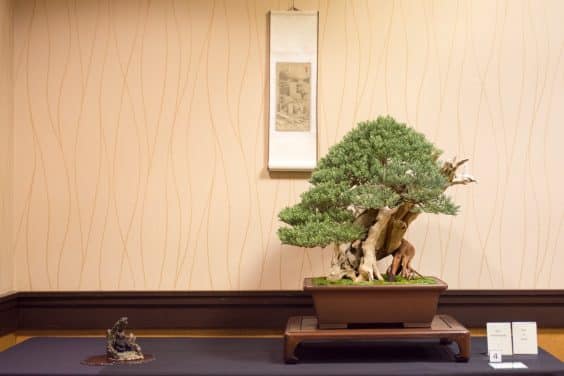
Garden juniper
Korean hornbeam
Korean hornbeam
Elm and cedar
It was nice for the auction to include some high-quality trees. Although the reserves on some of the nicer trees took some audience members by surprise, the numbers weren’t terribly out of line.
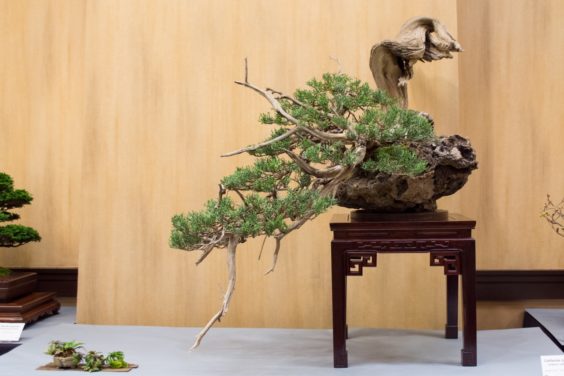
Shimapku on a rock
Japanese maple forest
Gordon Deeg barked while Jay McDonald hefted lots.
Gordon and Jay – 2013
For those of you who missed the event two years ago:
Gordon and Jay – 2011
The GSBS staff has the drill down. Hats off to them for executing another successful fundraiser.
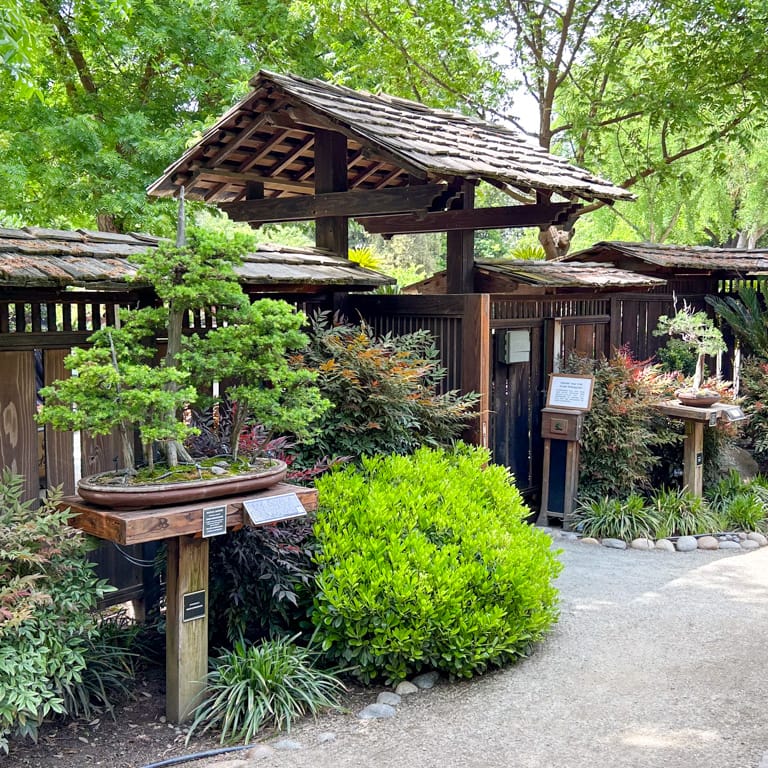
GSBF Bonsai Garden at Lake Merritt
I stopped by the Golden State Bonsai Federation’s Bonsai Garden at Lake Merritt after visiting the East Bay Bonsai Society’s 50th Anniversary Show. The weather was perfect for a stroll through the garden. Here are some of the trees that were on display.
San Jose juniper
Seiju elm grove
Hinoki cypress
Flowering apricot
Monterey cypress
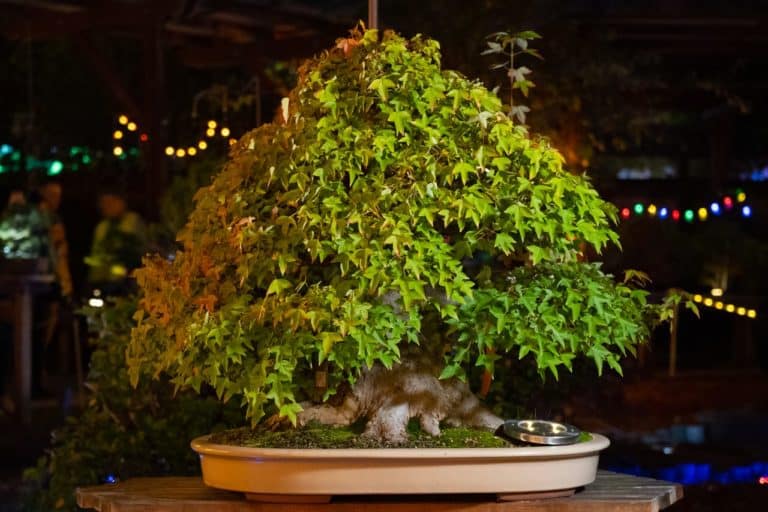
Trident maple
San Jose juniper
Trident maple
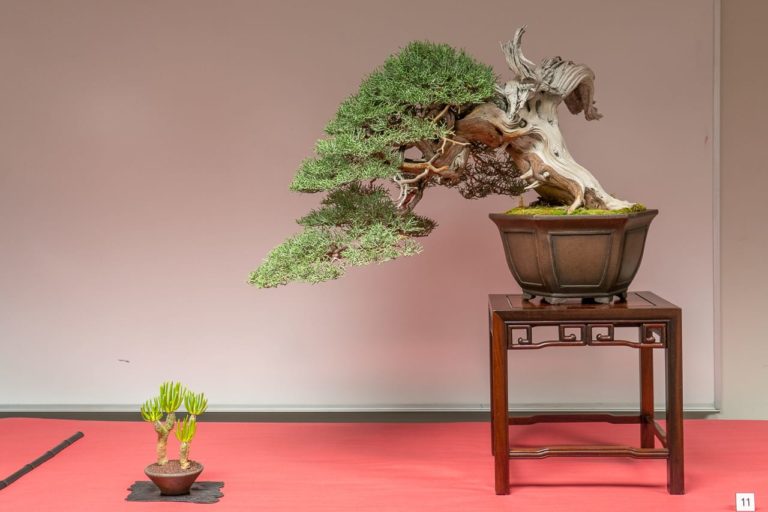
California juniper
Coast live oak/Carmel oak – note the small leaves
What’s with the white stuff?
A visit to the GSBF Bonsai Garden at Lake Merritt this spring will reveal an intriguing bonsai technique – paper-wrapped bonsai wire. I learned about the technique from the garden’s curator, Kathy Shaner, not long after she completed her apprenticeship to Yasuo Mitsuya in Toyohashi, Japan. Copper wire is more commonly used on conifers than it is on deciduous trees as copper can stain the trunks and branches of deciduous trees. The primary alternative to copper bonsai wire is aluminum. While aluminum doesn’t stain trunks or branches, it doesn’t hold as well as copper. The solution – paper-wrapped bonsai wire!
Hawthorn bonsai with paper-wrapped copper wire
Working with paper-wrapped wire isn’t bad – the trick is getting the paper on the wire. It takes a bit of practice. The paper is rolled onto a single section of wire at a time. The result is a funny looking tree – and if all goes well, there will be no scars.
Hawthorn – wiring detail
The garden does a good job of providing information about the care and maintenance of the collection. The paper-covered wire treatment elicited its own note:
What’s with the white stuff?
What you are looking at is wire that has been covered with paper. The wire is to shape the tree. The paper wrap is to protect the delicate bark from the wire. Most trees do not need to have the wire covered, as their bark is not as susceptible to wire marks. We will monitor the growth of the tree, and when the wire just starts to cut into the bark, we will remove it. If the branch does not stay where we placed it after putting on the paper wrapped wire, we will repeat the wiring. Normally one season of growth is sufficient for the branch to stay in place after the wire is removed.
Pomegranate with paper-wrapped wire, bamboo sections and irrigation lines
Pomegranate – wiring detail
The Garden at Lake Merritt’s website contains a lot of information about the trees in the collection. The weeping flowering cherry below, the site notes, is known as “shidare-higan-sakura in Japanese, or Prunus subhirtella.” It was donated by Pete and Amy Sugawara and was started some time around 1980.
Weeping flowering cherry, ‘Benihoshi’
I don’t know where one can find the paper used for this technique – which is fine, for the moment, as I have a lot of pines to wire.
GSBF Collection North
After visiting the GSBF Mammoth Fundraiser last weekend, I stopped by the Bonsai Garden at Lake Merritt. Spring is a great time to visit the garden as the quince are in bloom and the maples are just starting to leaf out. It’s also a good time of year to see the blooms that make the winter hazel (Corylopsis spicata) unique.
Winter hazel blossoms
Winter hazel (Corylopsis spicata)
The garden is home to the largest pomegranate bonsai I’ve seen. According to the garden’s website, the tree was “Dug from an old orchard (thought to have been planted in late 1800s) in Lodi by Vince and Kathy Owyoung. They donated the tree, Sept. 2002. Styled by Seiji Shiba. A glass jar was found embedded in the trunk. Potted at the Garden, Aug. 5, 2008.”
Pomegranate (Punica granatum)
Pomegranate – trunk detail
A number of Japanese maples had just started to leaf out. The new foliage is beautiful.
Japanese maple
Japanese maple foliage
Japanese maple – note bamboo used to arrange trunks
Japanese maple grove
I’ve watched the California juniper below develop for close to 15 years – it has an interesting curve to the trunk. From the website: “Collected in 1954 from the high desert region near Palmdale in southern California, this tree was styled about 1964.”
California juniper
The fruit on the citrus below puts the tree in perspective. Every visitor that passed by stopped for a closer look.
Orange


3 comments