Ebihara’s maples
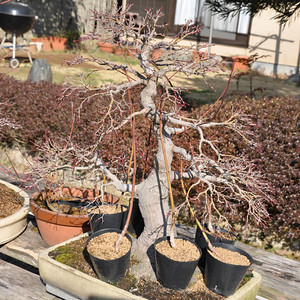
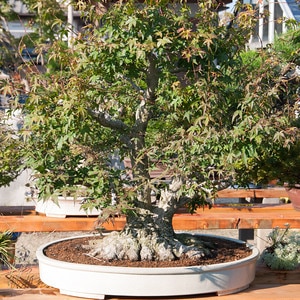
While Boon, Peter Tea and I were poking around Ishii’s nursery outside of Nagoya last year, we came across a number of great Japanese maples. They looked familiar to us, but we didn’t immediately figure out why.
Japanese maple
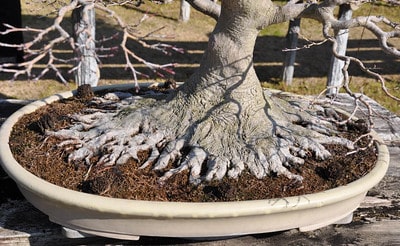
Great root base
Another substantial root base
A pair of maples
It was the first time I’d seen these trees in leaf, but all the signs were there – great trunks, interesting branches, and a familiar technique for removing large branches one section at a time that encouraged resulting wounds to heal quickly. These had been Ebihara’s trees.
Removing a large branch
The patient approach to branch removal
It appears that Ishii acquired many of Ebihara’s bonsai when Ebihara was unable to care for his trees due to health reasons. Boon and I had seen these trees in 2009 sitting on directly on asphalt with duct tape or drainage screen doubling as pots.
Maples at Ebihara’s garden, 2009
The containers remained the same at Ishii’s garden.
Developing maple in wood tray
No pot needed for now
We also spotted a zuisho project from Ebihara. This was one of a number of large trees undergoing many grafts in a long-term effort to produce big zuisho bonsai. What a fun project!
Zuisho
Ebihara Technique
It’s summer and everything’s growing gangbusters so I thought I’d mix things up a bit and write a few more posts about my trip to Japan this past February.
These photos were taken in Ebihara’s garden and provide clues to how he achieved such great results in so little time. I’ll leave the details to your imagination.
Ebihara
How many of you have, or would like to have, a tree with roots like this?

This Japanese maple is around 25 years old from cutting. And it’s fairly representative of all of the maples in Ebihara’s garden, located just outside of Tokyo, Japan.
I’m currently on a bonsai vacation that coincides with the 83rd Kokufu ten bonsai exhibit, an annual event held at the Metropolitan Art Museum in Ueno Park. Ebihara’s garden was my first stop on the trip.

Ebihara with Japanese maple.
Ebihara is crafty – he has developed a number of techniques to create good bonsai in a relatively short span of time. Some of his longer term projects are increadible, including the monster zelkova next to Boon below.

Ebihara very kindly took the time to talk, at length, about what it takes to develop deciduous bonsai. Below, he points out how to improve a tree’s roots from below.


Future Japanese maple bonsai.
Over the years Ebihara has produced a number of outstanding trees. And unlike many bonsai professionals in Japan, he only works on his own trees, selling just a few each year (3 in 2008). Based on the number of trees he’s currently working on (above right) he won’t run out any time soon.

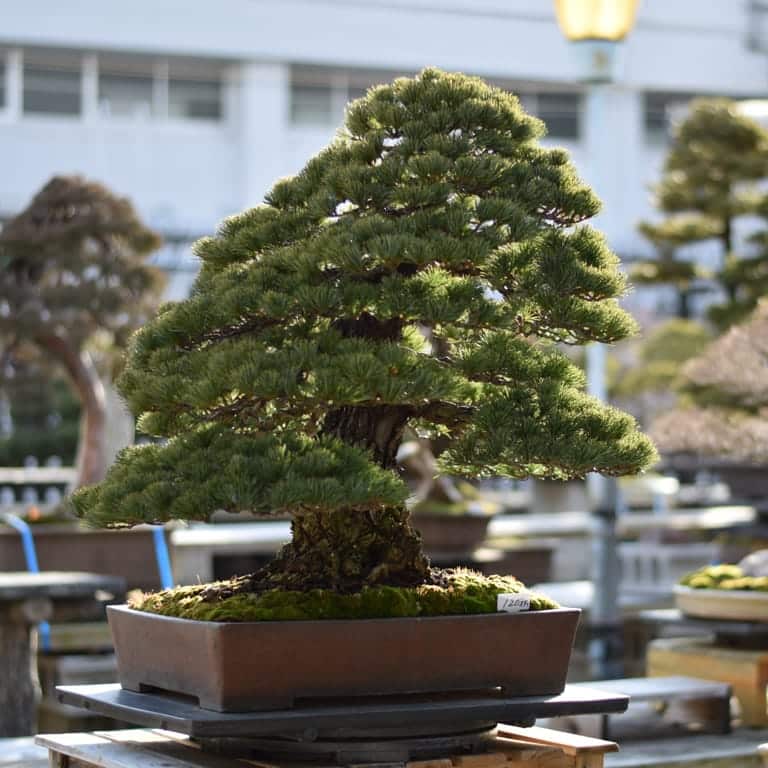
Japanese white pine.
Turns out he’s good with white pines, too. He’s working on a dozen or more giants (above left in 2′ box) and is nearly finished refining several others (above right).

Above is a white pine he’s styling before the air layer is removed from the rest of the tree.
His workshop, by the way, is very tidy.
The visit to Ebihara’s garden was a super way to start a trip. And as you might surmise from the sunshine in these photos, the weather has been great.

Apparently, he dabbles in shimpaku too.
Bonsai fertilizer – follow-up
Last month I began using tea bags filled with fertilizer to feed my bonsai. Unfortunately, it only took a few days for me to realize that this technique didn’t work well as implemented. The bags started disappearing immediately. Critters tore through some of the bags and carried others away completely, leaving behind the toothpicks that were meant to keep the bags in place. Somehow they removed all of the bags from my best trees and only a few of the bags on the developing trees – I won’t even try to solve that one. Instead, I’ll go back to my time-tested fertilizer method – clumps of cottonseed meal and fish emulsion.
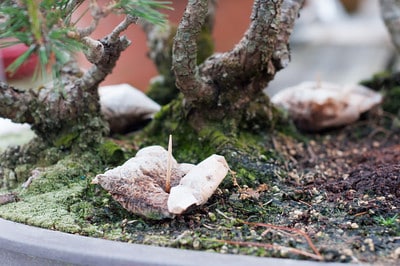
Tea bags intact on a pine forest
Tea bags on an exposed root pine
Cottonseed meal on a pine
More cottonseed meal
I usually start feeding my trees at some point between late January and mid March depending on the weather and the variety. If I’ve repotted a tree, I wait about 4 weeks before feeding it. I start by placing one or two clumps of cottonseed meal and add additional clumps every 1-3 weeks later until the majority of the pot is filled with fertilizer.
Cottonseed meal feeding a recently separated cryptomeria
I supplement the cottonseed meal with fish emulsion (see “Bonsai Fertilizer” for details). Fish emulsion is a great, if stinky, fertilizer that I’m comfortable using on all bonsai varieties. I usually apply fish emulsion weekly, though I might apply it more or less frequently at various times depending on the season, the weather and the variety.
Fish emulsion
Ebihara fed his trees with diluted liquid fertilizer every three days (I don’t know what type of fertilizer he used). Others primarily rely on dry fertilizer that releases food whenever the trees are watered. I haven’t noticed big differences between liquid, dry, or other categories of fertilizer, but I do find that consistent application leads to the best results. And the best results, of course, depend on the goal of the fertilizing program. If I’m trying to increase the size of the trunk, I fertilize a lot. If I’m trying to ramify delicate branches on deciduous varieties, I fertilize very lightly and only after new leaves have hardened off.
As for the tea bags, I haven’t completely given up. I may yet try chili powder or some other caustic agent that’s harmful to vermin but safe for trees. And if I can get this right, I will celebrate and then post the results.


8 comments