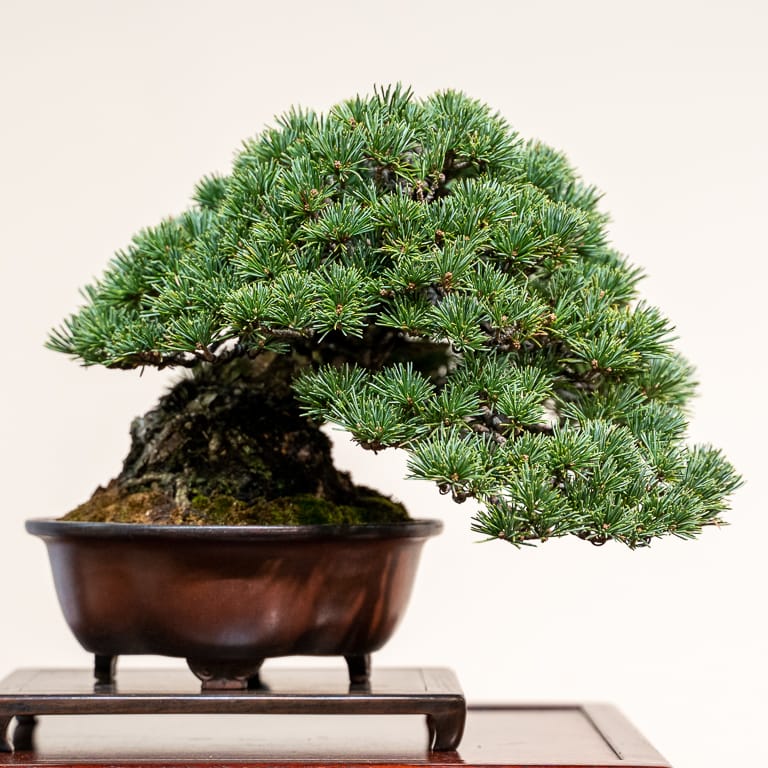
Shopping at the Asia-Pacific Bonsai and Suiseki Convention
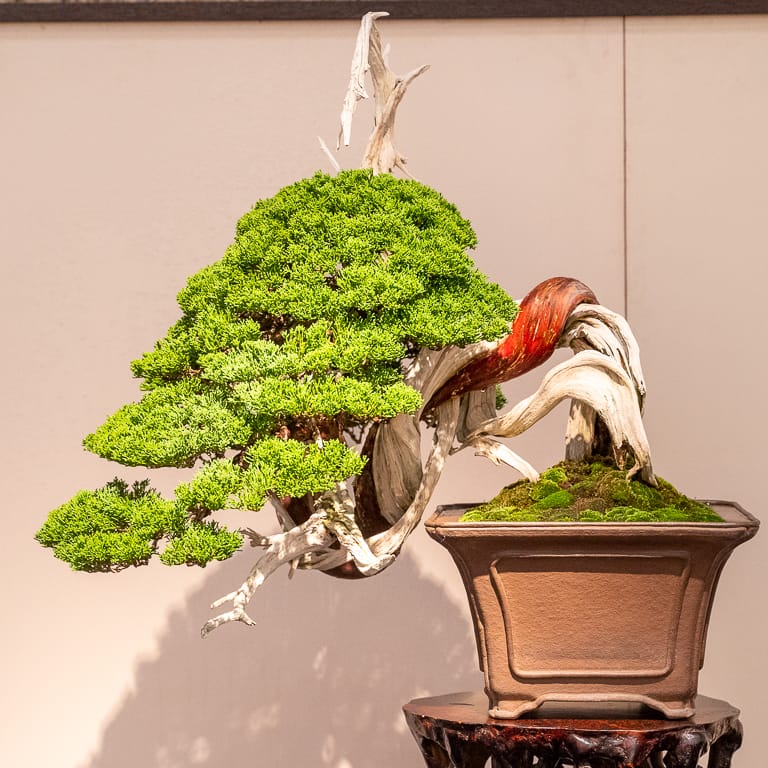
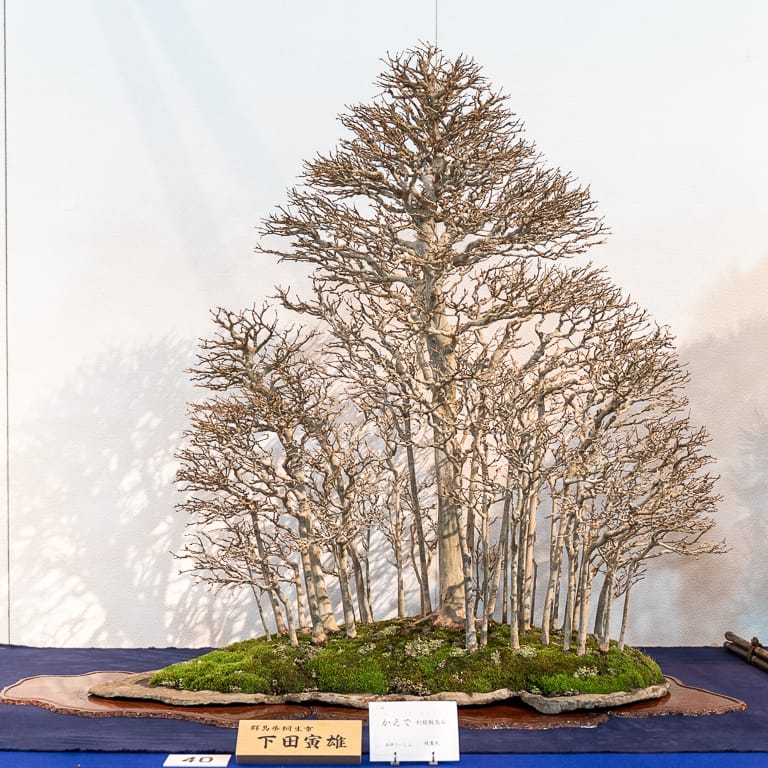
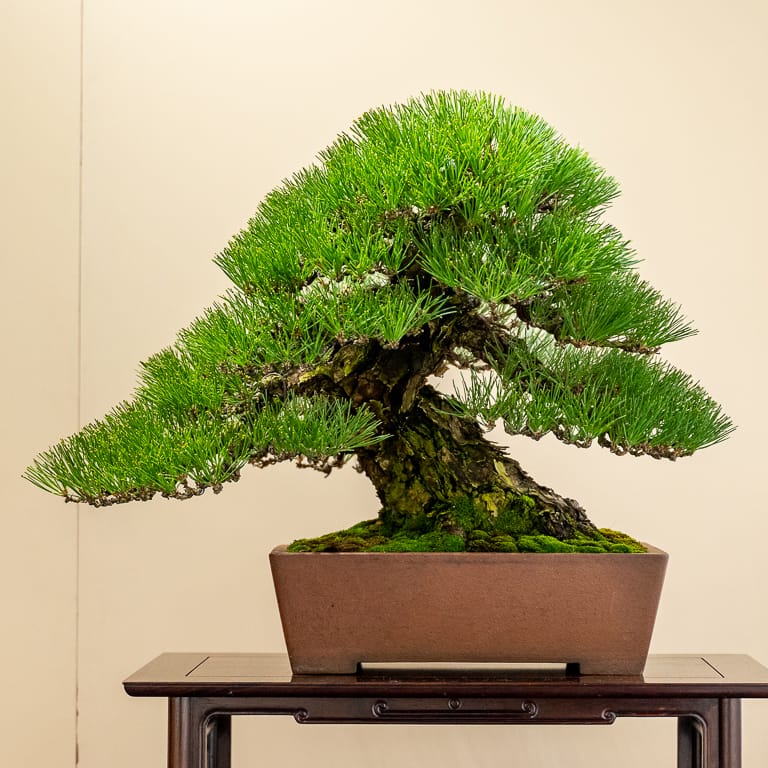
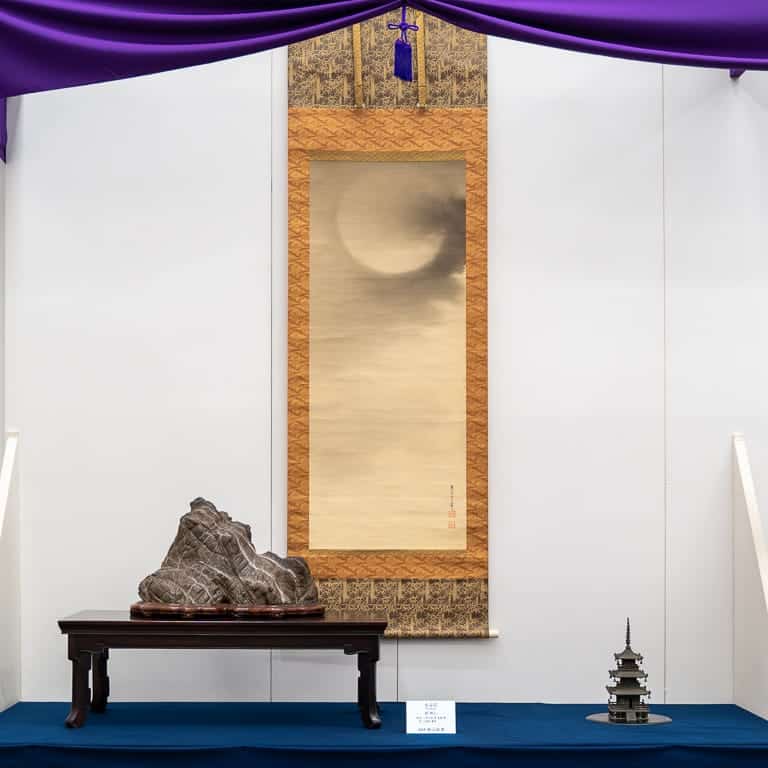
Ever wonder what it’s like to wander around a world-class bonsai convention held in Japan? It’s pretty great. Everywhere I turned I saw wonderful trees, tools, pots, stands and other bonsai paraphernalia. It was fun to see which trees came from which gardens and how much they cost. And because the quality was so high, it was like wandering, at times, through a giant, disorganized exhibit.
The location didn’t hurt either. The convention was held in Takamatsu, a port city on the north coast of Shikoku facing the Inland Sea. The region is famous for producing pine bonsai, lacquer-ware and udon. Convention events were spread between two adjacent hotels at Sunport Takamatsu.
Many vendors priced their trees on the high side with the expectation that some bargaining would precede the sales. This was particularly true for the more expensive trees. Less expensive items tended to sell closer to their posted prices.
Some people held off their purchases toward the end of the event in hopes of getting a better price. I tended to get what I could while it was still available. At one point I found a box of Kokufu books beneath a sales table – oh boy! In the time it took me to pick up half of the books, another convention-goer grabbed the other half.
By the end of the event, I had filled my bags with pots, tools, books and little quince slabs for displaying accent plants. It was the unpurchased trees, however, that left the greatest impression. What fun it would be to bring some of them home!
Takayuki Fukushima’s table
Junichiro Tanaka and Ken Fujiwara’s table
Peter Warren at Kunio Kobayashi’s sales tables
Antique stands
Antique root stand – likely priced well over $10,000
Little red and blue pots
Suiseki
Half of the vendors were situated in a tent right on the Inland Sea. The selection inside was great.
Detached vendor area
Trees for sale
Junipers for sale
One vendor filled two tables with nothing but shimpaku. They ranged from rough material to Important Bonsai Masterpieces.
Shimpaku – $1,800
Shimpaku – $1,800
Shimpaku – $21,600
Shimpaku, Important Bonsai Masterpiece – no price listed
Procumbens juniper
The quality really was amazing. Although S-CUBE set the high bar in terms of quality, many vendors offered outstanding trees.
Trident maple
Korean Hornbeam
Small deciduous tree in Koyo pot
Black pine
Assorted deciduous trees
Red princess persimmon – $190
A word about princess persimmons – although they look delicious, the experience of eating them is far from enjoyable. Like any unripe persimmon, princess persimmons are very astringent. So much so that after tasting one, my mouth wasn’t the same for a whole week. Has anyone else given these a try?
Bonsai demonstrations at the 11th ASPAC
I’d been curious how demonstrations in Japan differ from the demos I’ve attended closer to home. It turns out they aren’t that different. Bonsai professionals took breaks from their work to talk about the trees while assistants kept busy. Kimura’s demo involved some minor carving and a few large bends that resulted in a pleasing silhouette.
Demo tree, Kimura, Isobe
Shimpaku – before
Shimpaku – after
One standout difference was the number of translators. At one point, a Japanese Australian member of the audience – Megumi Bennett – took the stage to help out the English translator. This yielded one Japanese description, two Japanese to English translations, and one Japanese to Chinese translation all in the service of a single question. It was a start.
Lo Min Hsuan (bonsai professional from Taiwan), ASPAC official, Megumi Bennett, Shigeo Isobe, Masahiko Kimura
The audio-visual set-up was very well done. Lots of close-up camera work was great for conveying detail work to a large audience.
Close up of the chainsaw
The next day of the convention featured a double bill. Toru Suzuki’s pine demonstration occupied stage left while Shigeo Isobe’s azalea demonstration filled stage right.
At one point during Suzuki’s demonstration, the discussion turned to decandling and other more esoteric topics of pine bonsai maintenance. This proved challenging for a very capable Japanese to English translator who found her first exposure to bonsai on stage that day.
Harried translator and Toru Suzuki
Suzuki’s demo featured the styling and repotting of a clump-style Japanese black pine. Suzuki began work with a recent Daiju-en graduate, the talented Ken Fujiwara, but before long enlisted help from the Aichi-en duo of Junichiro Tanaka and Peter Tea. Together, the Daiju-en-happi-coat-clad team made quick work of the wiring.
Peter Tea, Junichiro Tanaka, Ken Fujiwara and Toru Suzuki work on a clump-style pine
I actually learned an important lesson during the repotting section of the demo about handling bonsai roots carefully. I’ll share the details when I have better photos.
Suzuki working on the roots
The pine was to be planted on a rock slab. When the time came for muck-work, Suzuki again called for help from the audience, enlisting assistance from a Hawaiian, Roy Yamashiroya, and a Californian, Dennis Makashima.
ASPAC visitors from Hawaii and California help with the repotting
Meanwhile, Isobe had turned a shrub into a wonderful azalea bonsai.
Azalea before and after
Satsuki azalea – after
After getting the muck into place, the assistants covered the muck with moss, creating a very nice slab planting.
Demonstration complete
High tech bonsai auction
Last year’s Asia-Pacific Bonsai and Suiseki Convention and Exhibit featured a high-priced, high tech, bonsai auction. Bidding was open to all convention attendees, so the trees went on display well ahead of the event. Some of the trees were awesome.
Shimpaku
Red pine
Black pine
Japanese maple
Shimpaku
The auction also featured antique pots and stands. I was tempted to bid and very curious how much these items would fetch.
Antique pot
Pots and stands
The auctioneer was an experienced bonsai auctioneer and pot expert. Microphone duties fell to the talented bonsai professional Isao Omachi of Sendai.
Auctioneer and Omachi
The auctioneer opened the auction in the traditional fashion – he barked, “Sei-no!” and we clapped three times: clap-clap-clap, clap-clap-clap.
The event then got off to a rocky start. The auction followed the conventions of the Japanese bonsai community. Rather than offering set prices and soliciting bids, the auctioneer asked if we had bids, and bidders named their offers. The Japanese in the room followed this convention while some of the westerners indicated bids with gestures. Adding to the fun, translators provided English and Chinese versions of the bidding. This is where the high tech kicked in. Video projections of each tree filled a huge screen above the stage with graphics showing prices in Japanese yen, US dollars, and Chinese yuan.
Suiseki
Antique pot
The projection system worked very well, and the translators kept pace without making mistakes. Bidding, however, never really took off. Throughout the convention, many discussions had focused on the anticipation of rich Chinese buyers making the event a huge success. As over half of the registered attendees were Chinese, hopes were high. At the auction, however, most bids came from Japanese professionals. As a result, few lots sold beyond their actual value.
Shimpaku on the block
Of course, the numbers were much higher than any I’ve seen in California bonsai auctions. Good trees here went for good money.
Satsuki azalea
The numbers in these photos don’t all correspond with the final bids – the trees were removed and the screens cleared right as bidding stopped.
Red pine from Korea – one of the demonstration trees
I didn’t end up bidding, but I thoroughly enjoyed the event. I’ll say more about the rest of the convention next week.
The bonsai of Aichi-en
I always appreciate the different approaches bonsai professionals take with their gardens. Some gardens are filled with exhibit-ready trees while other gardens are filled with project trees. Some focus on a certain size or variety of tree while others include bonsai of every description. At a glance, it’s clear that the focus at Aichi-en is on pine bonsai. White, red, and black pines fill the majority of the garden, and there are more large trees than medium or small sized bonsai. Trident and Japanese maples comprise the bulk of the deciduous trees, but these sit beside quince, ume and hornbeam among other deciduous varieties. There are junipers, cryptomeria, and many other trees whose names I do not know.
From the roof of Mr. Tanaka’s bonsai workshop, one can get a sense of how many trees fill his garden.
Aichi-en from above
More garden and the family house
Tanaka keeps some trees on the workshop roof.
Rooftop garden
Many of the garden’s project trees were kept on the rooftop. The nicer trees were situated closer to ground level.
Root over rock Japanese black pine
Black pine
Pine
Red pine
Black pine
Most of the kifu-sized trees shared a staggered table near the house.
Kifu bleachers
In fall, the colors were wonderful.

Bonsai Fall color
Up close, the trees were wonderful. Two of the garden’s Zuisho were outstanding.
Japanese five needle pine – ‘Zuisho’
Zuisho bonsai
Considering the small size of Zuisho needles and branches, these are remarkably full trees.
The same tree from above
The Japanse maple beside the front gate turned a wonderful shade of red.
Japanese maple
The pieris below sits right inside the front gate.
Pieris bonsai
I snapped these shots during short breaks or early in the morning – those precious moments when I was free to appreciate the trees in the garden. Back in the workshop, I appreciated the trees one at a time. The black pine below was one of the last ones I worked on at Aichi-en. I removed all of the old needles and some of the new from the strong areas. In weak areas, I removed some or all of the old needles. I also cut a few small branches where more than two emerged from the same place. It was very basic pine work, but it made the tree look a lot better.
Cascade Japanese black pine
New, old, and dead needles
After removing old, dead and some new needles
Fall work complete
That’s the story for a single pine. With all of the pines in the garden, that’s a lot of tweezer work.


2 comments