The following photo is a clue to the location of our next stop:
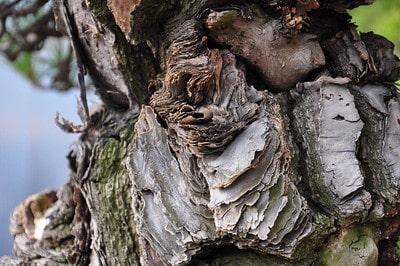
Pine bark
You guessed it – Daiju En, one of the world’s more famous pine bonsai gardens. And it’s the family home of my teacher’s teacher’s teacher.
My teacher, Boon Manakitivipart, studied in Japan with Kihachiro Kamiya, student of Toshinori Sukuki. Daiju En was started by Toshinori’s father, Saichi Suzuki, one of the pioneers of modern bonsai who is famous for popularizing decandling techniques and the ‘zuisho’ variety of five-needle pine. Today Toshinori’s son, Toru Suzuki, carries on the family tradition at Daiju En.
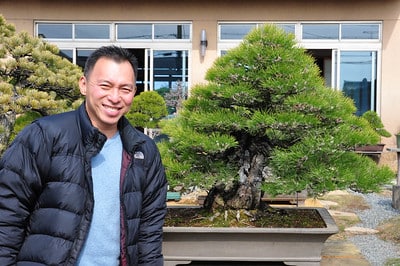
Boon and Fudo
Boon is posing here with “Fudo,” a famous black pine featured on the cover of Kindai Bonsai’s “Black Pine Special,” a great publication from Kindai the 1990s. Like so many trees in the garden, Fudo has all of the characteristics one looks for in black pine – great roots, branches and needles, and above all, outstanding bark.
This was one of the gardens I was most looking forward to visiting on my first visit to Japan. Having studied the Black Pine Special for years before that trip, I was looking forward to seeing trees in person that I had become familiar with through pictures. Seeing them in person was better than expected.
One of my favorites from that first trip was the tosho below, parked, this year, in the same place I found it 10 years ago. It is a very good specimen of the variety.
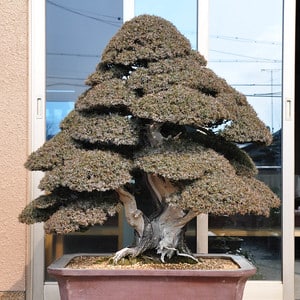
Needle juniper
In addition to housing many outstanding conifers, Daiju En is home to a number of noteworthy deciduous trees including the Chinese quince and flowering quince below.
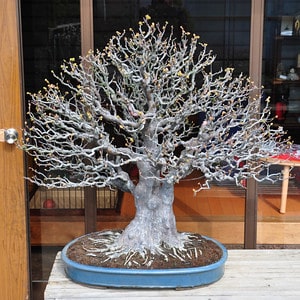
Chinese quince
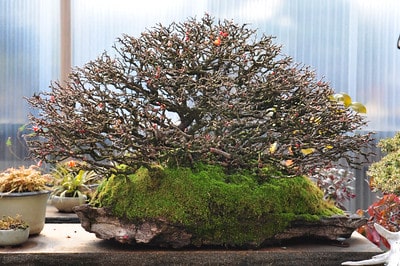
Flowering quince, ‘Chojubai’ planted on a rock
Unlike Chinese quince, the ‘chojubai’ variety is very slow growing. The above tree could easily be over 100 years old. Of all of the surprises upon my first visit to Japan, the biggest was that I fell in love with this variety. What often looks twiggy and shapeless in photos can look ancient and beautiful when viewed in person. And above all, its flowers – particularly the orange ones – glow in a hue not frequently seen in the garden.
Pines, however, are what brought us to Daiju En.
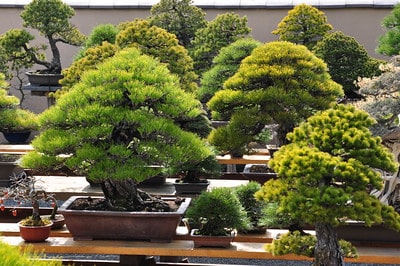
Daiju-en Pines
I am tempted to say that they all blur together after a while, but when each tree possesses character like pine pictured below, it’s hard to gloss over any of the trees in the garden.
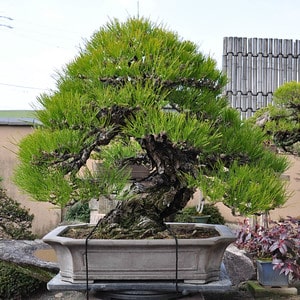
Black pine
What of the next generation of Daiju En? Below are Isao and Yusuke, the current apprentices studying with Toru. Both are off to a good start. And as both speak passable English, they are primed for visits abroad in the not too distant future.
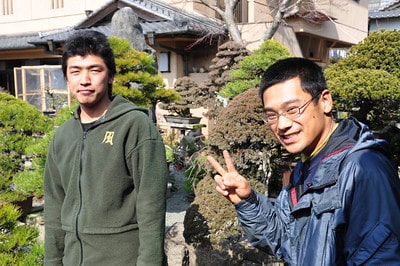
Isao and Yusuke
Subscribe to Bonsai Tonight
New Posts Delivered Every Tuesday and Friday
Dannon says
Wow! Great trees! Does this bonsai nursery still accept students from abroad?
xwires says
Good question – I don’t know the answer. I’ll post a note if I can find out.