Bonsai Tonight

From landscape tree to bonsai – part 2

Posted in Bonsai Development by Jonas Dupuich on April 20, 2012

There are only so many ways to make a bonsai smaller – and cutting and bending seem to do most of the work. As my newest pine was almost two meters tall, some cutting was in order. Although I have yet to decide on the future of the tree, it’s clear that I don’t need the top branches in the final design.

The first cut

Making the first cut

The first cut

Red-sleeved arms provide assistance

I halved the top remaining branch with my second cut. That was enough to get the tree into the workshop for further refinement.

The second cut

Halving the top branch

Even after making these reductions, this is still a large pine at over three feet across.

The second cut

Not a small tree

Once I got the pine into the workshop, I cut some heavy secondary branches and removed old needles. Then I started repotting. I removed the nursery soil from half of the rootball and planted the tree in a mix of akadama, lava, and pumice.

Barerooting half of the rootball

Bare-rooting half of the rootball

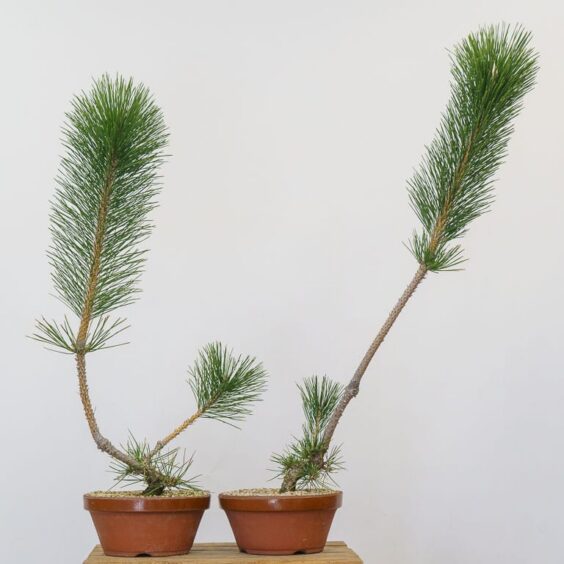
The resulting three-branched tree leaves me with several fun options for the future.

After plucking old needles

Cutback, needle removal and repotting complete

I’ll admit, one hypothesis struck me immediately when I first saw the tree. I don’t know if it’s a great idea, but it’s made me curious. What I do know is that I want to show off the base of the trunk, especially on side B (see “From landscape tree to bonsai“). Hint – here’s a photo of the tree that got me thinking in this direction.

Black pine

Japanese black pine displayed at the 2011 Gomangoku in Okazaki

Tagged with: , , ,

From landscape tree to bonsai

Posted in Bonsai Development by Jonas Dupuich on April 17, 2012

As most of you know, it can be hard to find good material for black pine bonsai outside of Japan. This forces a certain level of creativity. Growing seeds is one good approach. Another is converting landscape trees to bonsai.

I recently purchased a couple of black pines developed as landscape trees in the hope they could someday become bonsai. The larger of the two was taller than I am.

Black pine

Black pine developed as landscape tree

Black pine

Black pine

Despite the large size and uninteresting trunk line, the tree possessed a couple of characteristics that made me think hard about working with the tree as bonsai. The base of the trunk is fairly large, and good bark is beginning to develop.

Trunk detail

Base of trunk – side A

Trunk detail

Base of trunk – side B

A good trunk is a great start for a tree, but branches also matter, and this tree had but a small number of quite large branches. I didn’t have long to think about it, but I knew I had some intriguing starting points so I brought the tree home.

What, then, to do with it? I’m curious to hear your suggestions. I’ll post photos of the initial work later this week.

Tagged with: , , ,

Developing young pine bonsai

Posted in Bonsai Development by Jonas Dupuich on April 13, 2012

A number of my black pines are turning eight this year. Some are starting to look like young bonsai. Others simply look young. As none have grown to the size I have in mind for them, the work at this stage is straight forward.

I’ve trained the tree below in the exposed root style. This year’s goal for the tree below is increased growth. To keep it from blowing over, I removed the uppermost shoot.

Before

Before cutback

After

After cutback

I have yet to select a trunk or main branches, but I suspect the final tree will be somewhere in this area.

Closeup

Exposed root pine

Most of my young pines have small shoots near the base of the trunk that will form the future branches. Longer escape branches serve to thicken the trunk. To keep the lower branches on the tree below in check, I cut them back and wired them down.

Before

8yr-old pine with long shoots

After

After cutback and wiring

I also replaced the tree’s trunk by wiring a branch upwards and tying it to the stub from the previous trunk. Changing the main trunk like this is a good way to add movement and produce taper.

Another young pine was getting floppy. I wired the trunk a few years ago with some very tight curves. The weight from the long escape branch made the tree bounce around in the wind. To keep the branch from moving around too much and snapping the trunk, I removed some of the excess foliage.

Before

Before cutback

After

After cutback

Some trees are puzzles to me. I’ve found that some of the trickiest  - read: least attractive – simply require more time before the future direction becomes clear. I’m hoping light cutback and another year or three of new growth may help with this one.

Before

Future bonsai?

After

Future landscape tree?

Some of the smaller trees produce no strong feelings in me. I’ll let these grow another year before making any cuts.

Before

8yr-old pine

Closeup

Plenty of small branches

I really like this stage of development because the work is simple and the effect on the tree’s future can be huge. Some of my most hopeless cases have turned into really fun trees. The rest are growing nicely – as landscape trees.

Tagged with: , , ,

Refining trident maple

Posted in Bonsai Development by Jonas Dupuich on April 10, 2012

I’ve been working to develop the ramification on my trident maple for several years now but the progress has been slow. This year I’m trying something different to see if I can speed up the process.

I usually let new shoots run a bit before trimming them and I defoliate the tree 2-4 times a year depending on its vigor. This year I’m going to keep new growth in check by maintaining the tree’s silhouette throughout the growing season. To do this, I will trim all vigorous shoots as they emerge, even if this means working on the tree every few days.

That’s the plan anyway – it’s early April now and I’m already behind! You can see in the photo below that the apex has rounded out some and a few shoots are breaking away from the silhouette.

Before cutback

Trident maple – healthy apex

I cut back all shoots that were leaving the general silhouette and left the interior branches alone. When the new leaves harden off, it will be time to defoliate – another opportunity to cut elongating shoots.

After cutback

After removing the new shoots

I’m hoping that keeping the vigorous shoots in check will improve the tree’s balance. If, however, I don’t see much progress by the end of the year, I’ll look to try yet another approach next spring.

Tagged with: , , ,
Follow

Get every new post delivered to your Inbox.

Join 558 other followers