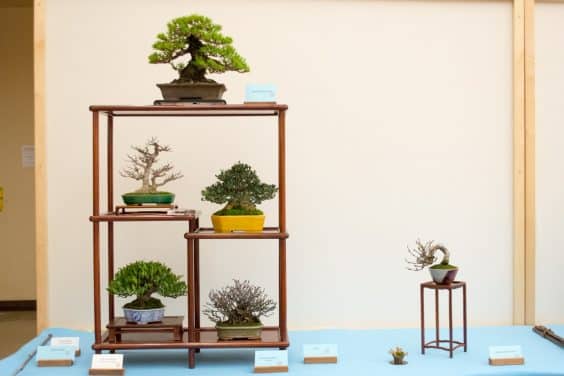
Bay Island Bonsai’s 13th annual exhibit
After hosting ten exhibits in Hayward and two in Pleasanton, Bay Island Bonsai moved its annual exhibit to the Lake Merritt Garden Center in Oakland, California. The 13th annual event was a big success, drawing crowds of experienced bonsai folk as well as many who are new to the art. As the Garden Center contains two large rooms, we displayed all large bonsai in one room and all small and medium sized bonsai in the other. I really liked the split. At previous exhibits, large, impressive, trees like the black pine below would invariably end up next to much smaller trees. It was tough for the smaller trees to compete. By presenting like-sized trees together, following the convention employed at the Kokufu exhibit in Japan, it was easier to appreciate every tree in the room.
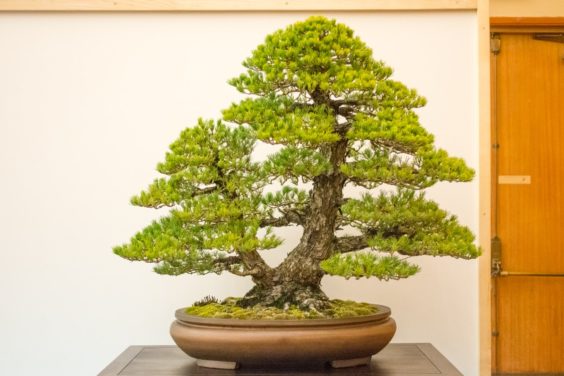
At the center of the exhibit was an old roughbark Japanese black pine that belonged to Mas Imazumi. It has long been a favorite of mine.
Roughbark black pine – Chinese antique pot
About ten years ago the tree was much weaker than it is now. I expect its renewed health will lead to some styling enhancements in coming years.
One of the fullest trees in the exhibit was a prostrata juniper. The tree is large – and heavy! It is also well-balanced, suggesting clear movement to the right.
Prostrata juniper
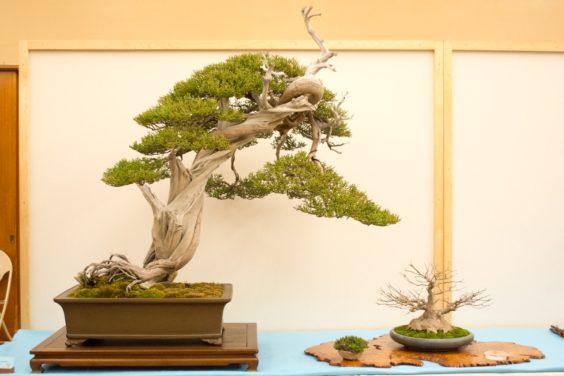
A Western juniper, only a few years out of the ground, made an interesting contrast to the prostrata juniper. Its young foliage hints at the tree’s future shape, leaving the viewer to appreciate the interesting movement and deadwood characteristic of many collected Westerns.

Western juniper

Japanese black pine

Shimpaku
The blue atlas cedar below has been a fun project. I helped repot it more than ten years ago during its initial styling. Planted in a 20-plus gallon container, the tree taught me how useful a reciprocating saw can be during repotting season. Now far more refined, the tree is well on its way to become an impressive cedar bonsai.

Blue atlas cedar

Cork bark black pine

White pine
The semi-cascade white pine below is another favorite of mine. The delicate foliage provides a nice contrast to the heavy trunk. One of two white pines once affixed to a large stone by Yasuo Mitsuya, the pine has more recently found its home in a custom-built pot by Michael Hagedorn.
White pine – Michael Hagedorn pot
Scots pine

Shimpaku – old Yamaaki pot, Kinkazouin
Japanese black pine

Shimpaku – Chinese antique pot, check out the feet!

Japanese black pine
Japanese black pine – Chinese antique pot
Exposed root red pine
The exhibit featured deciduous bonsai as well. Although not as well-represented as the coniferous trees in the exhibit, the bare trees suggested that BIB members appreciate a wide variety of bonsai.
Stewartia – Michael Hagedorn pot
Trident maple
Ume
Ginkgo
Catlin elm
Star magnolia – Chinese antique pot
Japanese maple
Trident maple – Koyo pot
Japanese maple
The broadleaf evergreens, on the other hand, were simply not well-represented at this year’s exhibit. That will change in future exhibits. For now, here’s an olive that has only been trained as bonsai for a few years.
Olive – off to a great start
Mas Nakajima provided an installation of his suiseki art for the exhibit. I heard several explanations behind the arrangement, but my favorite comment about these stories belongs to Mas: “Too much story,” he said. The painting, and the stones, were a welcome addition to the exhibit.
Suiseki art by Mas Nakajima
Looking for directions
I had a lot of fun setting up Bay Island Bonsai’s exhibit this year. Having recently returned from Japan, I found myself looking at trees in a very different light than I had before the visit. I now get much more enjoyment from flowering and fruiting trees, and I’m even more fascinated by the idea of balance in bonsai. On that note, I’ve really appreciated the recent discussions about whether certain trees point left or right. If an idea as simple as direction can lead to such rich discussions, either the trees in question – or our understanding of said trees – offer opportunities for improvement.
The crabapple below provided some much appreciated color to BIB’s exhibit. Discussion arose, however, as to the direction of the tree. More and more, I skip past the idea of which way a given tree points and start asking which way the tree could or should point. In other words, what can be done to a tree to enhance its balance or to clarify its direction?
Crabapple
The main branches on my trident maple are fairly horizontal and somewhat similar in size. Over time I plan to vary the angles at which the primary branches extend from the trunk and create more differentiation in branch size to improve the tree’s balance. I hope that in time to make it clear that the tree moves to the left.
Trident maple – antique Chinese pot
A number of nice shimpaku made it into this year’s exhibit, including the two well-balanced trees below. Both get their sense of direction from the trunk more than from the foliage. Although people often respond strongly to direction of the upper part of the trunk or the foliage, it’s typically not enough to outweigh the sense of direction provided by the lower trunk.
Shohin shimpaku
Kifu shimpaku
A small red pine provided an interesting example. The first branch indicates strong movement to the left. The foliage suggests movement to the right. It’s tough to say which way the trunk leads the eye.
Red pine – nanban pot
I’ve always enjoyed this tree. For the exhibit, it was placed on the left side of the display, but Boon suggested that in the future it could go the other way. Tilting the tree slightly to the left made it clear that the tree has good potential to point left. Some minor branch work could complete the makeover.
Red pine – tilted
Next week I’ll post photos of trees that more clearly know where they are going.
Daisaku Nomoto Bonsai Award
Bay Island Bonsai was fortunate this year to have Daisaku Nomoto around to help with its 13th annual exhibit.
Daisaku Nomoto
Nomoto, Boon’s senpai at Kihachi-en, wired trees, prepared moss top-dressings, and carried many trees before, during, and after the exhibit. Somewhere along the way, he took a liking to a Western juniper. So much so, it became the recipient of the first Daisaku Nomoto Bonsai Award.
The winning tree – Western Juniper
Nomoto is a fan of trees styled in this fashion. The tree has a somewhat bunjin-gi feeling, but has a more substantial trunk and silhouette than typical bunjin bonsai. The tree is full, healthy, and well balanced. I’ll add that it points to the right.
Having seen the tree develop since it was collected, I can say that it’s come a long way in a very short time. It is a deserving recipient of the first Daisaku Nomoto Bonsai Award.
The award
Kondo critique at Bay Island Bonsai
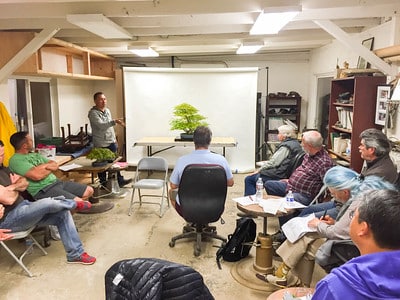
This month’s Bay Island Bonsai meeting was devoted to a bonsai critique by Akio Kondo. Kondo discussed the good and bad points of each tree, making suggestions for improvement and answering questions along the way. Occasionally – to our general encouragement – he pulled out scissors and made a few cuts. Here are some of the trees he looked at.
Japanese maple
Kondo thought this Japanese maple is well on its way. The tree has good roots thanks to an air layer. Kondo suggested that the best time to layer maples is right before new leaves open in spring.
Japanese maple – uniform roots are a sign of layering
Jim Gremel brought a San Jose juniper with kishu shimpaku foliage. We talked about the pot. The ideal pot would be somewhat smaller, maybe with scalloped edges.
Shimpaku
Shimpaku – trunk detail
Kondo also suggested making a small jin. After cutting away the foliage, Kondo recommended filling the gap with a small branch.
New jin – look beneath the apex on the left
Filling the gap
Kondo next commented on a California juniper with shimpaku foliage.
Sizing up a California juniper
He made basic recommendations for the main branches. He wanted the first branch on the right to be larger and a little lower; the left branch could be lowered; and the top right and left branches at the base of the apex could also be lowered.
Kondo indicating future branch positions
Another California juniper proved tricky. The narrow trunk emerged vertically before expanding and teetering off to one side like a wave. To improve the taper of the tree, Kondo recommended changing the soil line.
California juniper – trunk detail
Suggested soil line
Planting the tree deeper and changing the angle at which it is planted would widen the base of the trunk and make the tree appear more powerful.
California juinper – right side
Kondo’s advice for a cork elm was simple – all of the main branches needed to be lower. He suggested using guy wires and doing the work incrementally to avoid stressing or breaking important branches. He thought a “white” pot – what we would consider to be dirty white or even yellowish – or blue pot, oval in shape, would make a good container for exhibit.
Cork oak
A third California juniper elicited a term from Kondo with which none of us were familiar. He said the tree could be an example of the kawarigi style, a style in which all of the branches emerge from roughly the same spot. I’m not confident that we fully understood what he was trying to convey about the style. We were clear, however, when he mentioned refining the jin at the tree’s apex and suggested a front for the tree that made good use of the deadwood along the trunk.
California juniper
A prostrata juniper proved a good exercise in selecting the front of a tree. Here’s the tree from the current front.
Prostrata juniper – current front
Kondo suggested tilting the tree slightly to give it better movement.
Prostrata juniper – new front
He then pointed out the good deadwood on the other side of the trunk. This, he suggested, would make an even better front.
Trunk detail with deadwood
Kondo thought the front without deadwood would make a good front maybe three years from now, and that the alternative front would make a good front roughly 10 years from now.
Future front
Using this front would take longer because the branches needed to complete this front need more time to develop. For both fronts, Kondo recommended making the silhouette much smaller to improve the balance between foliage and trunk. He also suggested grafting two new branches in the tree’s interior to fill some open areas.
I’ve always liked the idea of taking advantage of different “fronts” over time. In the case of this prostrata, the owner can show the tree sooner rather than later and still have a somewhat “new” tree to show down the road.


7 comments