The topic for this month’s Bay Island Bonsai meeting was air layering. It’s a fast way to create new bonsai – much faster than starting trees from seed or cutting. It’s also a great way to correct defective roots as layering typically produces a good radial root base.
Boon described for us two approaches to layering. The first was a technique often used on beech. To cut off sap flow and stimulate roots, two aluminum wires are applied adjacent to each other. The wires are applied tightly so they dig in a bit. The area is then wrapped in moss to provide moisture for the new roots.

Justin demonstrating the 2-wire technique of air-layering beech
The second method is the more familiar of the two – removing a section of bark below the spot where new roots are desired. Layering is typically done at two points in the growing season – early spring and late spring. Trees that root easily like wisteria or cryptomeria can often be layered in May and separated in fall. Maples can be layered in May as well, but it may take two years before they can be separated.
Boon demonstrated this technique for us on a Shishigashira Japanese maple. He started by cutting two rings around a branch with a grafting knife below the spot where the new roots are desired and removed the bark between the rings with knob cutters. Here is the branch after removing the bark.
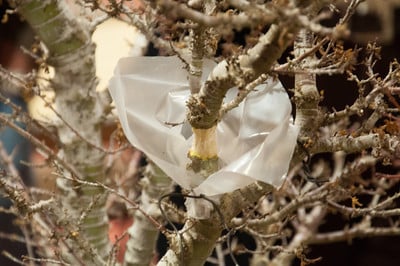
After removing the bark
A small sheet of plastic is secured to hold the moss in place, but before the moss goes in, root hormone is applied.
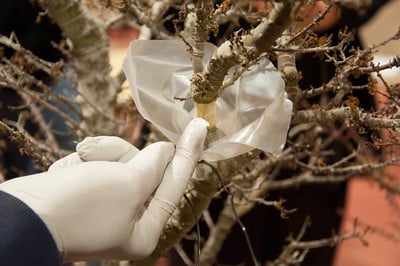
Using gloves to apply root hormone
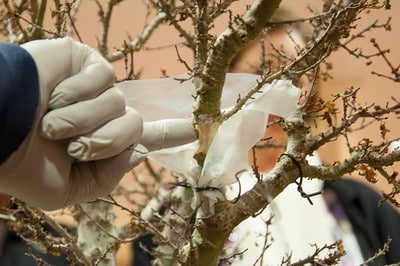
Applying root hormone
Next, the plastic sheet is filled with moist sphagnum moss and wrapped with aluminum wire.
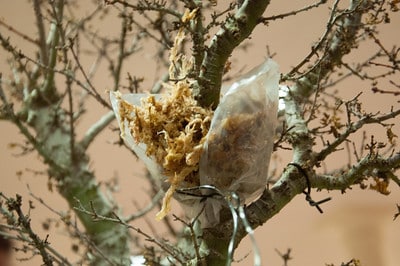
Adding moss
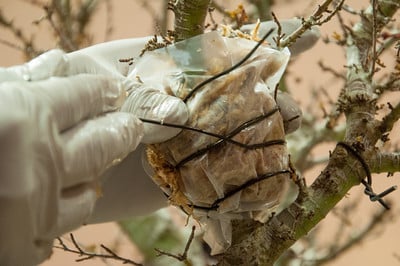
Wrapping the ball of plastic and moss with wire
Boon then poked holes in the bottom of the plastic with scissors to let the moss drain.
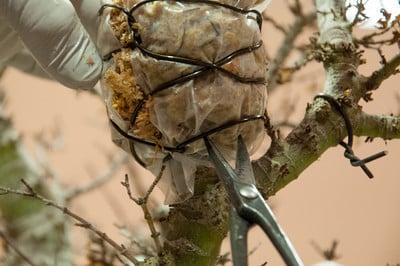
Poking drainage holes with scissors
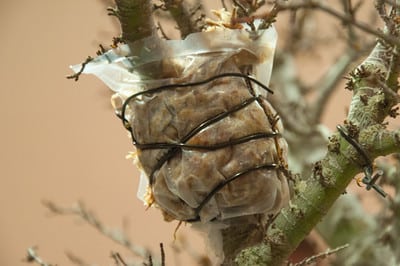
All wrapped up
If this branch sprouts enough roots, it will be removed in fall or winter, otherwise it will be removed the following year.
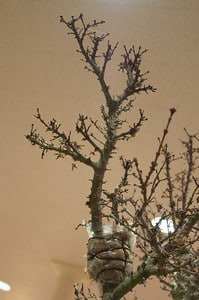
A new tree is on the way
Subscribe to Bonsai Tonight
New Posts Delivered Every Tuesday and Friday
brendenstudio says
Great ‘how to’ thanks for sharing!