When I have the time, I test out every container I can find when I’m repotting to see which I like best for a given tree.
Size is the most important attribute to consider (to keep the tree healthy), followed closely by shape. From there I consider color and quality (I don’t like using show containers when trees are in development).
The more I’ve tested different options, the more I’ve learned about which attributes of a container can complement, or fail to complement, a tree’s best characteristics.
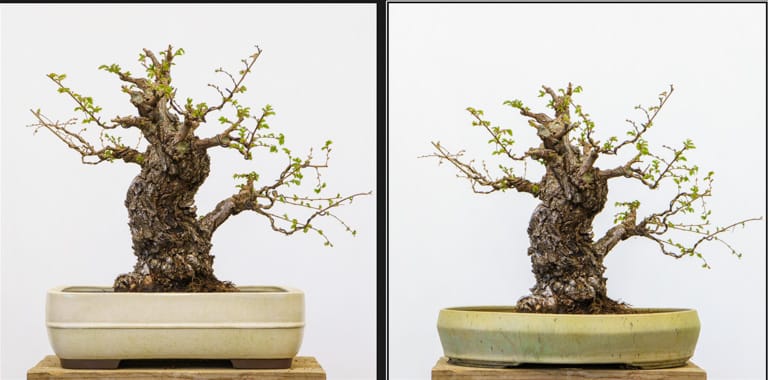
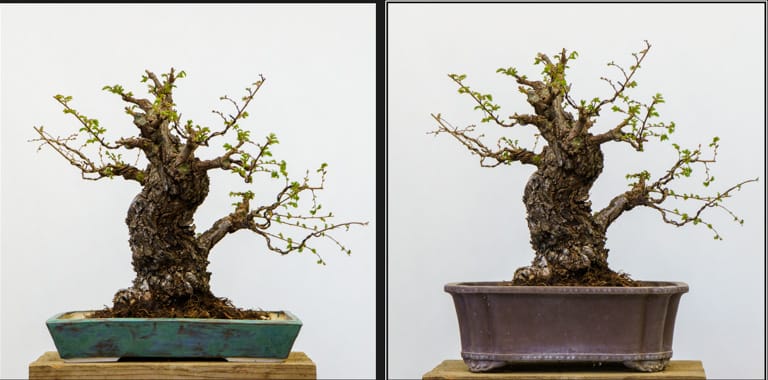
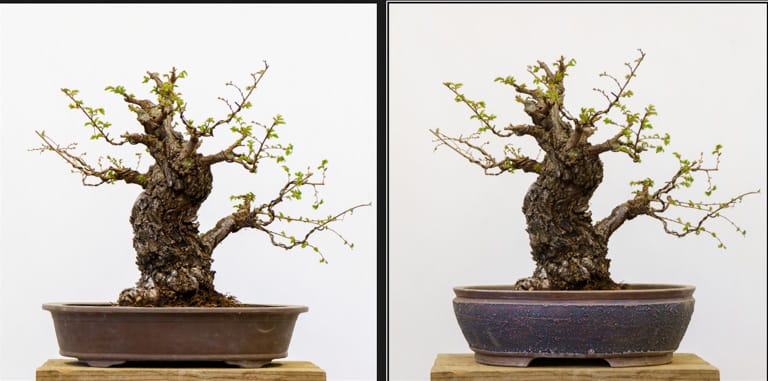
While repotting a Chinese cork bark elm this winter, I realized I had a lot of options on hand. We looked at fourteen different containers, many of which would make a good new home for the tree. Here are the options shown in pairs to give an idea of the effect that color and shape can have on the selection process.
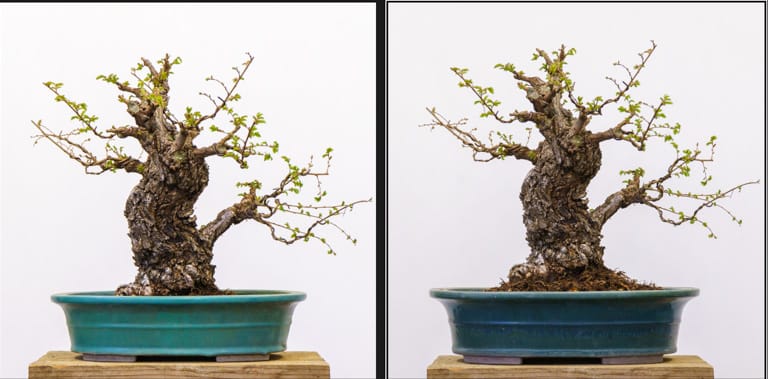
Options 1 and 2, Yamaaki ovals
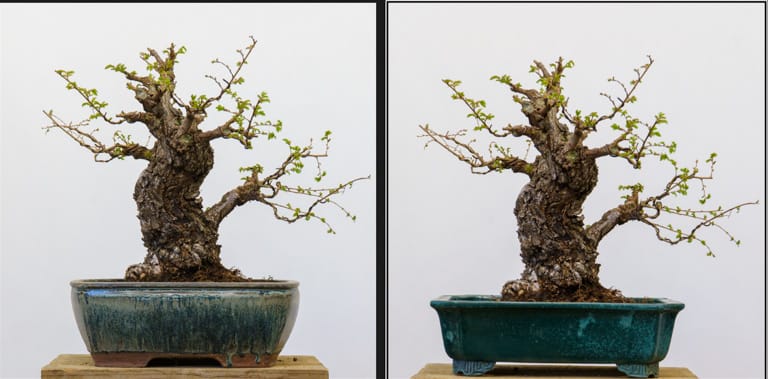
Options 3 and 4, Rayner and Shuho
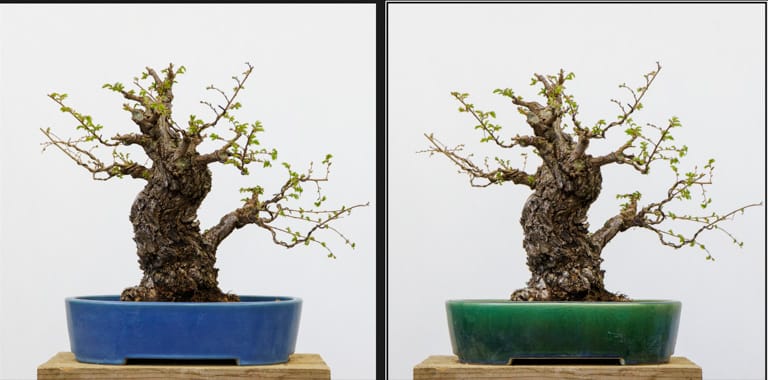
Options 5 and 6, Mazan ovals
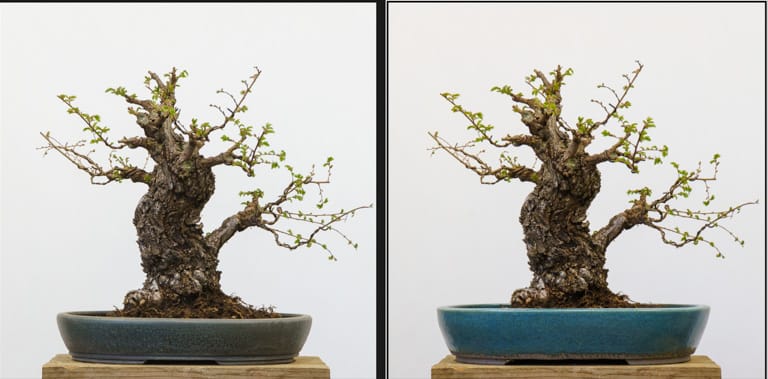
Options 7 and 8, Rayner and Mairhofer
Options 9 and 10, Yamaaki and Atkins
Options 11 and 12, Hanna and Chinese unglazed rectangle
Options 13 and 14, Chinese unglazed oval and Rayner
I went with a green oval not because it was my favorite but because I thought it was a good match for the current stage of development. The size and shape are about perfect for the tree, and the color is dark enough that it’s a good match for the dark, craggy bark.
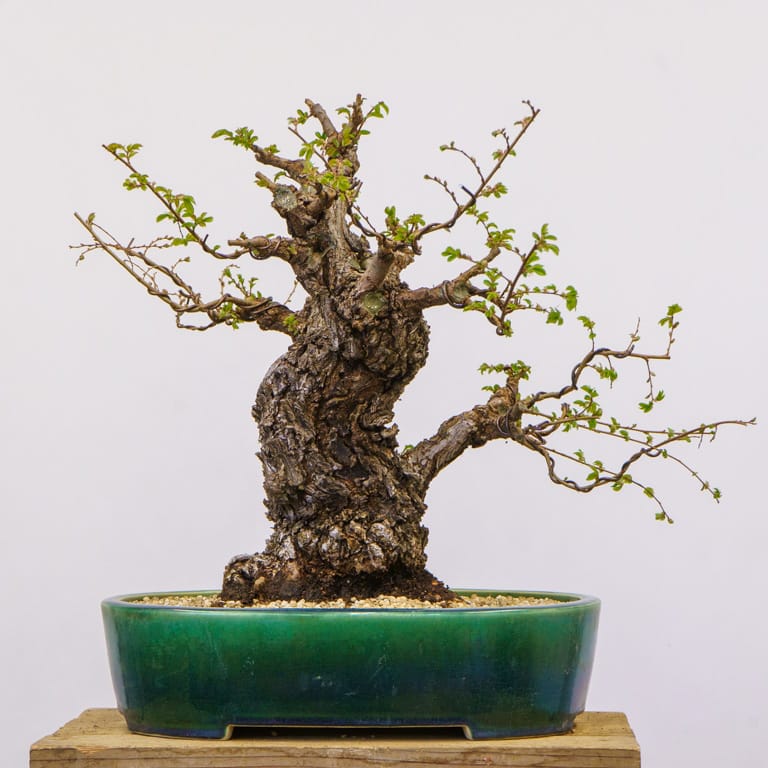
Chinese cork bark elm in glazed oval by Mazan
To give a quick rundown on the other containers, I can say that the first two options are both too “heavy” for the tree. They’d be suitable for a more massive tree with a larger trunk.
Options three and four have less pronounced lips and may be good options if the crown fills out with lots of heavy branches and lots of small twigs.
Five and six are a bit deep for the trunk but the simple shapes are a nice fit. Seven and eight are shallower but I don’t know that the shapes of these ovals are as effective at complementing the shape of the trunk (they might be better with trees with more flare low on the trunk). Comparing five and six with seven and eight can give insight to whether one prefers brighter colors or more subtle colors.
Although nine and ten are both nice colors for the tree, both feel overly heavy for the tree. Nine is too deep and ten is too wide. Were ten smaller and the silhouette of the tree much wider, it could be a good option.
Eleven and twelve are outliers. Eleven offers the most drama whereas twelve would only be an option if the silhouette were much larger and even then it would still be a bit much for the tree.
Finally, thirteen and fourteen are fine options for training pots. Thirteen has no characteristics that show off the tree’s best features unlike fourteen which calls attention to the texture of the trunk. A slightly smaller version of fourteen could work if one is going for a more quiet approach to container selection that eschews color.
Looking back over the options above, I wish I had something red as bright colors can be fun for trees with craggy bark.
Have any other suggestions? Feel free to make them in the comments below.
News & Updates – World Bonsai Day Edition
[Northern California Tree Sale]
- Lotus Bonsai is hosting their annual sale in Placerville, California, on May 16-17 from 9:00 a.m. to 5:00 p.m. both days. This year’s event is unique as all of their trees are for sale. To learn more about the nursery and find contact information so you can plan your trip, visit the Lotus Bonsai Nursery website.
[Washington D.C. Area Event]
- The Potomac Bonsai Association’s Potomac Bonsai Festival is this weekend. Held each year on World Bonsai Day weekend, the Festival is hosted on the grounds of the U.S. National Arboretum. The weekend activities include bonsai displays, display critiques, vendors, workshops, demonstrations, bonsai learning sessions, children’s activities, and museum tours. Former curator of the Arboretum’s bonsai collection Jack Sustic and I will provide the critiques and demonstrations.
I’m really looking forward to the event and I hope to see you there! For more information and a complete schedule, visit the PBA website.
[Pacific Northwest Event]
- The Pacific Bonsai Museum is hosting its annual Bonsai Fest this weekend from 10-4 on Saturday and Sunday. The event features a show, demonstrations, shopping opportunities, and the opening of Bonsai United, the highly anticipated exhibition focusing on the impact of culture on bonsai style and development. Learn more about Bonsai Fest and Bonsai United on the Pacific Bonsai Museum website.
Subscribe to Bonsai Tonight
New Posts Delivered Every Tuesday and Friday
Dawn Koetting says
Super article, great to hear your takes on a large number of pot options! The number of pots was the key – we often see 2-4 choices when considering a pot. This allowed a more detailed discussion!
Joe Graviss says
Jonas, this is a great exercise that really helps with your excellent reasoning detailed out. That’s why you’re the best in the blog business (and in general!) I was wondering the reason why you centered the tree in the pot versus of to the side a little? Thanks again!!
Jonas Dupuich says
Thanks Joe! Good question about the location in the pot. The trunk is located a bit left of center, but the silhouette is more to the right. I’m thinking the tree will flow left which is why the silhouette is right of center, but that means the trunk is relatively centered. I’ll see what location makes sense when the branches are more developed and make final decisions then. Thanks!
Joe Graviss says
Thanks so much!
JohnJCBonsai says
No 7 for me is a better shape, size & colour to create harmony.
Paolo macchi says
All Sara Rayner pots were pretty good but for that tree 14.