Imagine you’re in charge of maintaining the trees in the National Bonsai & Penjing Museum’s Chinese Pavilion. Your experience is with bonsai, but from a Western perspective. You begin with a tree like the black pine below.
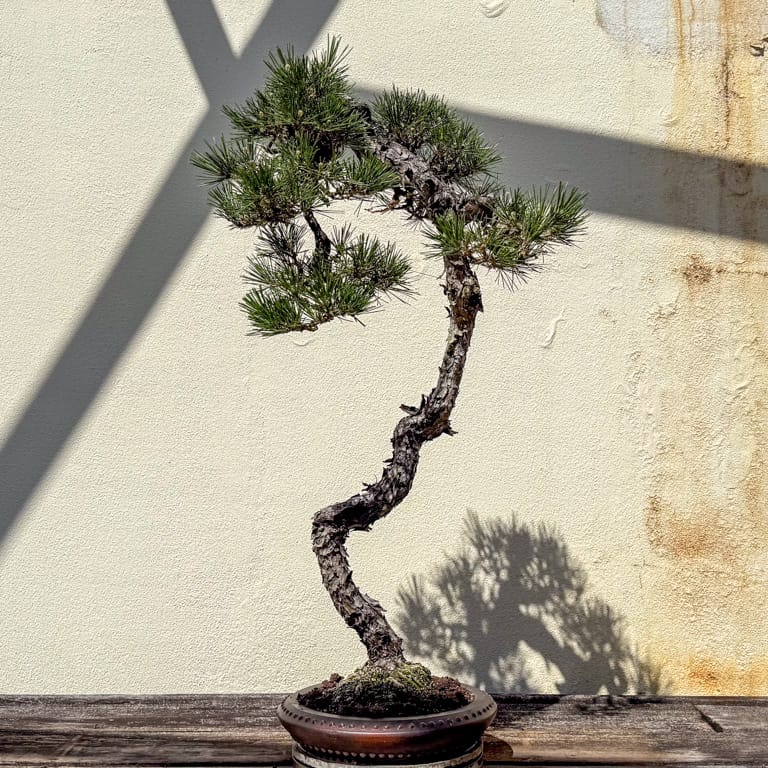
Japanese black pine
The tree appears to have been trained as a literati, or bunjin bonsai, but it’s in the Chinese Pavilion so you look for signs that the tree may have been trained with different aesthetic goals in mind.
Nearby, another pine catches your attention. This one differs from your idea about what bonsai, or possibly what penjing, typically look like. You look closer.
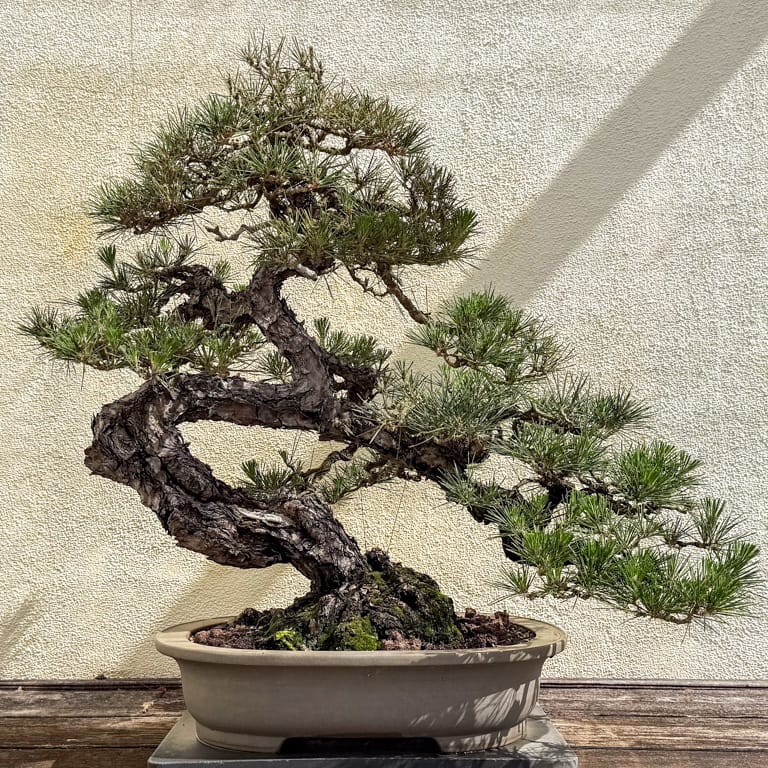
Black pine
There’s a roughly asymmetrical silhouette, the foliage is arranged in pads, and the primary branches extend mostly downward from the trunk, and yet the tree looks different somehow.
Thinking about how penjing differs from bonsai can be a fascinating exercise whether or not you’re familiar with concrete design goals for either approach to growing small trees in containers.
The trees in the Chinese Pavilion offer wonderful opportunities to study the apparent differences between bonsai and penjing. They might lead you to ask, is there room for both in my collection? Are there ways of incorporating one approach with the other for a given tree? Are some trees better candidates for development one way or the other?
Consider the Chinese elms below. The first may not look out of place at most bonsai exhibits.
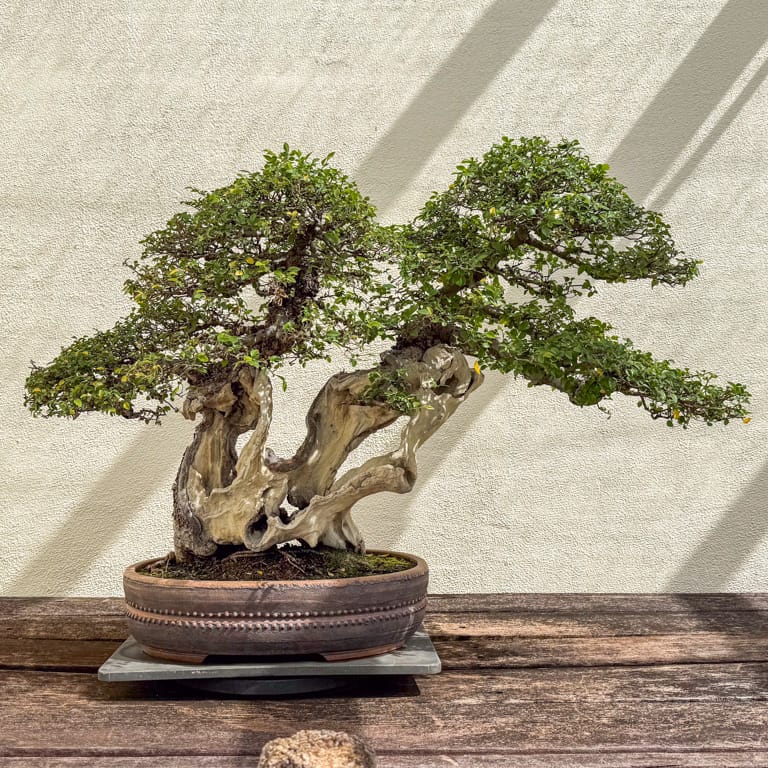
Cork bark Chinese elm
The second might catch our attention – or is it a typical example of a wind-influenced design?
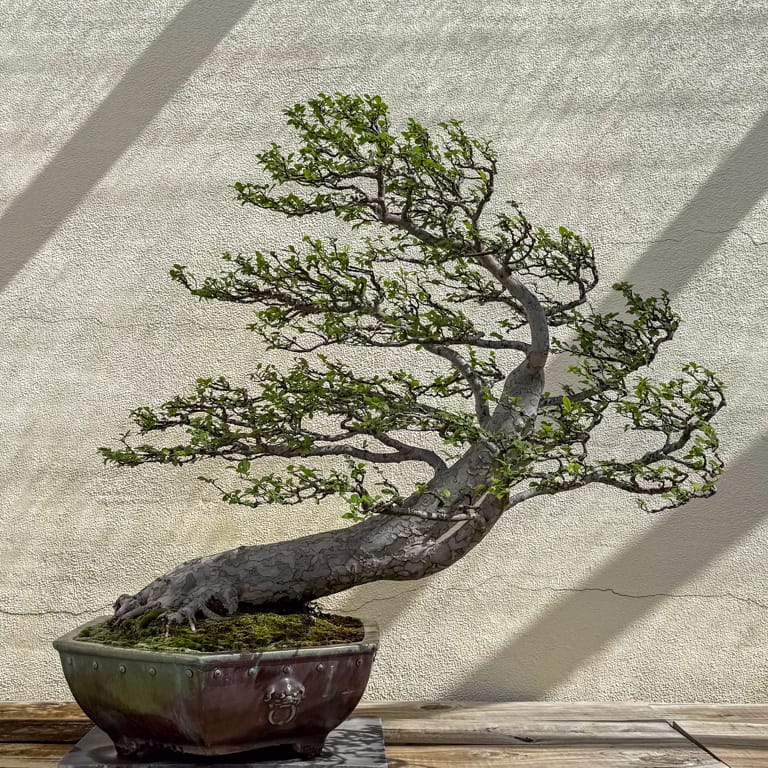
Chinese elm
The above elm suggests that the line between bonsai and penjing may involve extent. For example, it’s common to create bonsai designs in which a tree takes on a form that evokes an environment with strong prevalent winds. If we dial this up, a tree may look like its branches are actively blowing in a strong wind. As our artistry suggests stronger and stronger wind, do we cross into penjing or can we still say we are working within common conceptions of bonsaI?
We can apply the same questions to basic design precepts. The trident maple below is a good example of a tree with a trunk that mostly flows to the right but the apex and key branch both flow to the left – a very common pattern. The trunk, however, is in this case composed of exposed roots – a less common feature of trident maple bonsai.
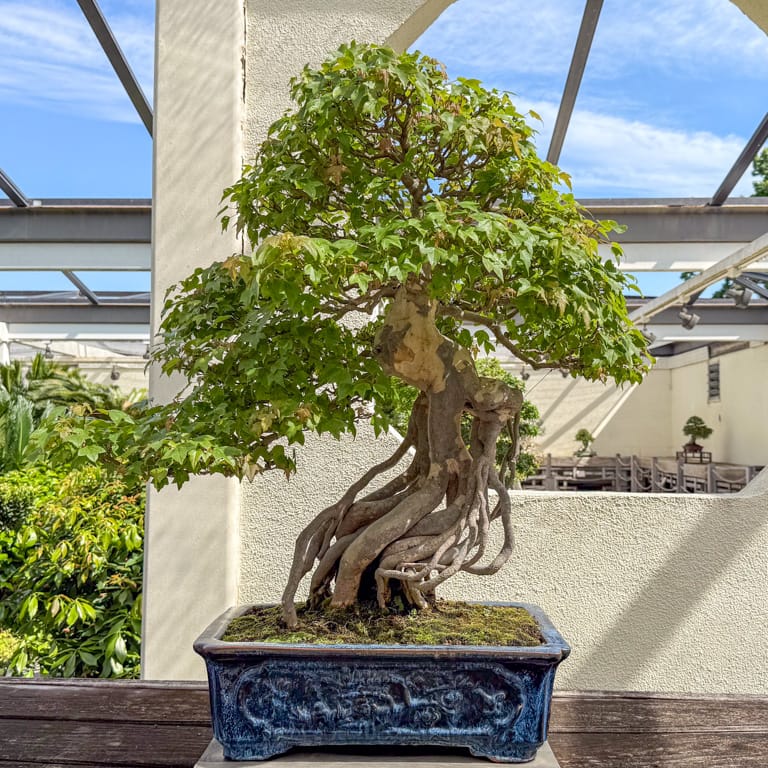
Trident maple
What if we keep the basic elements the same but exaggerate the height of the upper trunk – is this still bonsai or have we ventured into penjing territory?
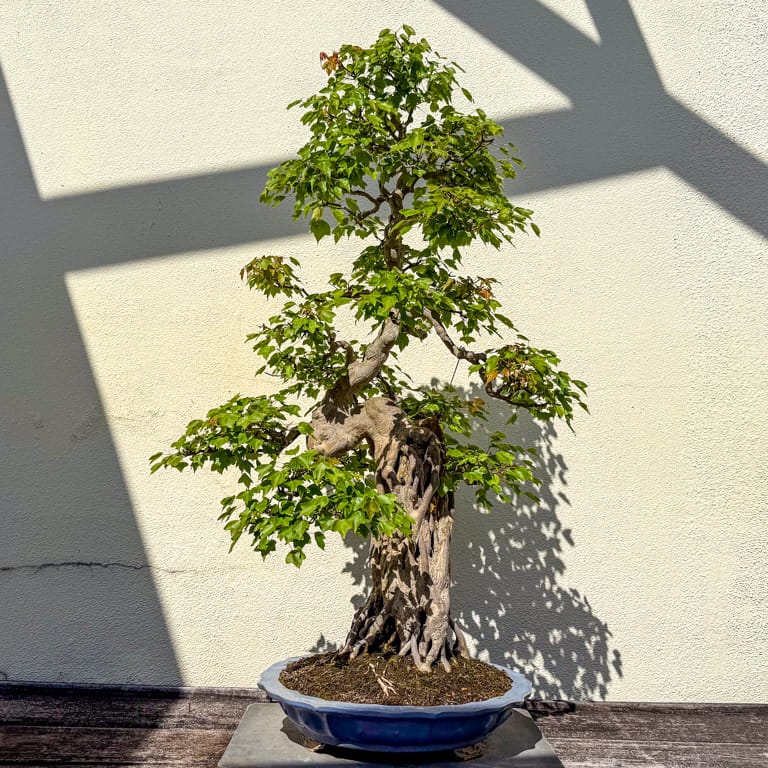
Trident maple
What about when there are multiple apices, key branches of great length, and very strong indicators of flow to the left and right – have we crossed a line from bonsai to penjing?
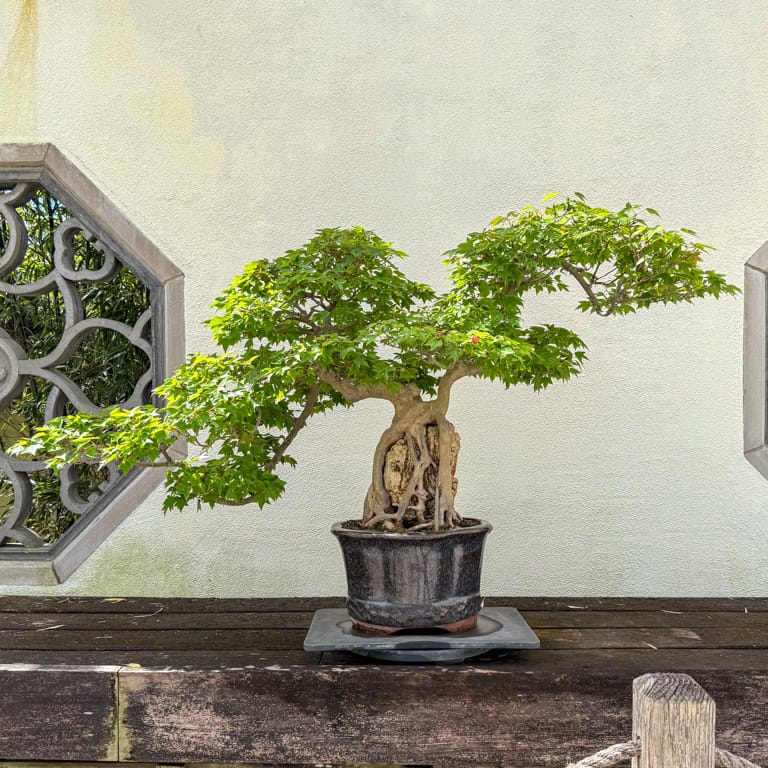
Trident maple
Because I’m not well-versed in the tropes of penjing design or familiar with the techniques, I try to leave judgement aside and focus on appreciating the differences in approach. I also look for signs that the trees have been carefully cultivated over long periods of time.
The branches on the pauper’s teas below show great age and make for very compelling designs.
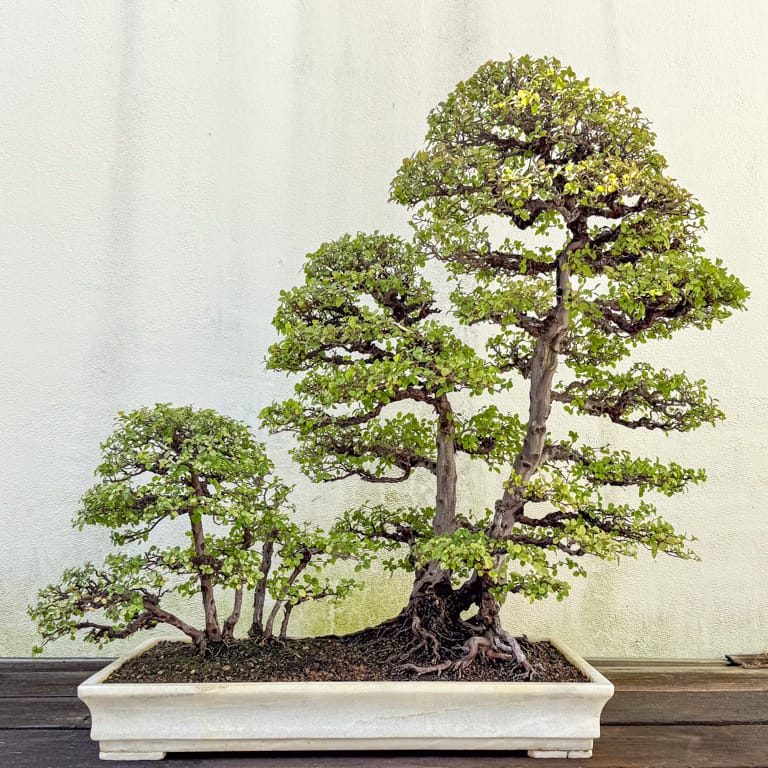
Pauper’s tea – Sageretia thea
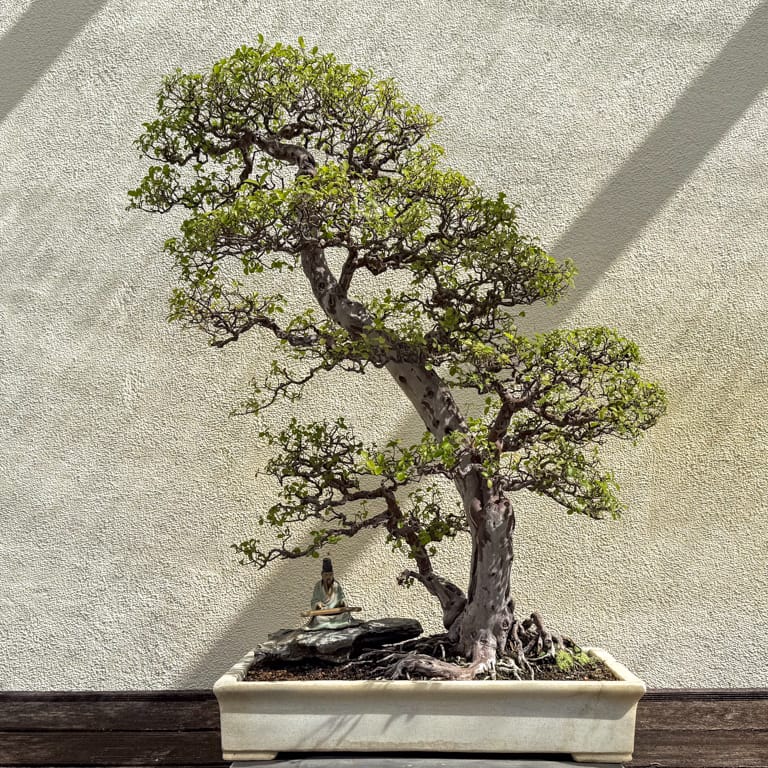
Pauper’s tea
Both Pauper’s teas have branches that convey great age (the branches have good size, movement, taper, and complexity), but they aren’t like each other (the former’s branches are mostly lateral whereas the latter’s branches extend upwards as much as outward).
I really appreciate the work that Michael James and the curator’s team at the Museum do to keep these trees in shape. It can’t be easy to work in different idioms, but I imagine it’s a lot of fun.
Subscribe to Bonsai Tonight
New Posts Delivered Every Tuesday and Friday
John C says
Absolutely, Penjing influenced, and very well done, right down to the Chinese pot choices.
I have penjing in my collection and live in both worlds of bonsai. Also, as a comment, if it weren’t for Chinese monks creating Penjing, then there wouldn’t be bonsai.
The other thing is that these trees are stunning; penjing also gives you the advantage of creating something spectacular with a tree that you would normally walk past in a nursery without a second glance, thinking only Japanese Bonsai.
Mats Hagstrom says
Jonas,
Thank you for another excellent post and for sharing your experience at the National Bonsai & Penjing Museum. It was a great reminder of just how many world-class trees and national treasures can be found in the Washington, D.C., area.
Here in California, we’re fortunate to have three public bonsai collections. It’s a large state, so they aren’t convenient for everyone, but we’re still better off than many enthusiasts elsewhere.
The Huntington Library, in particular, is well worth the trip. Its bonsai collection is outstanding, and the penjing collection is especially remarkable. I only wish I had a deeper understanding of the principles of penjing and how they differ from the Japanese approach to bonsai.
There may be some truth to the observation that Japanese bonsai can sometimes favor a more stylized, “mushroom-like” silhouette. Perhaps there is something we can learn from our Chinese counterparts and the broader artistic perspective that penjing offers.
Your insights and contributions are always appreciated and never taken for granted.
Thank you again,
MH
vance hanna says
Jonas,
So well said! Penjing has been around (from what I’ve read here and there ) for well over 3000 yrs and yet we who pretty much practice the Art of Bonsai still have quite a bit to learn. Having been to China two different times on business I was constantly amazed at what I saw ‘here and there’. I did not have the time or opportunity to directly head to centers of Penjing but on light trips throughout less traveled cities I certainly was stunned at the character and size as well as in many cases huge public diplays of penjing.
I did make the time to venture to Xijing pottery district as I’d had a connection there prior to the 2000 MABA event.
Your descriptions and detailed analysis of the National collection is concisely what it is: deeper study and knowledge of this forerunner of modern Japanese bonsai.
Well done! Thank you for your presentation.
PS I was at the US gift from Japan collection in 1980 and again in ’88. Our club the Four Seasons Bonsai of Michigan was a ‘donor’ and is mentioned on the Stone plaque.